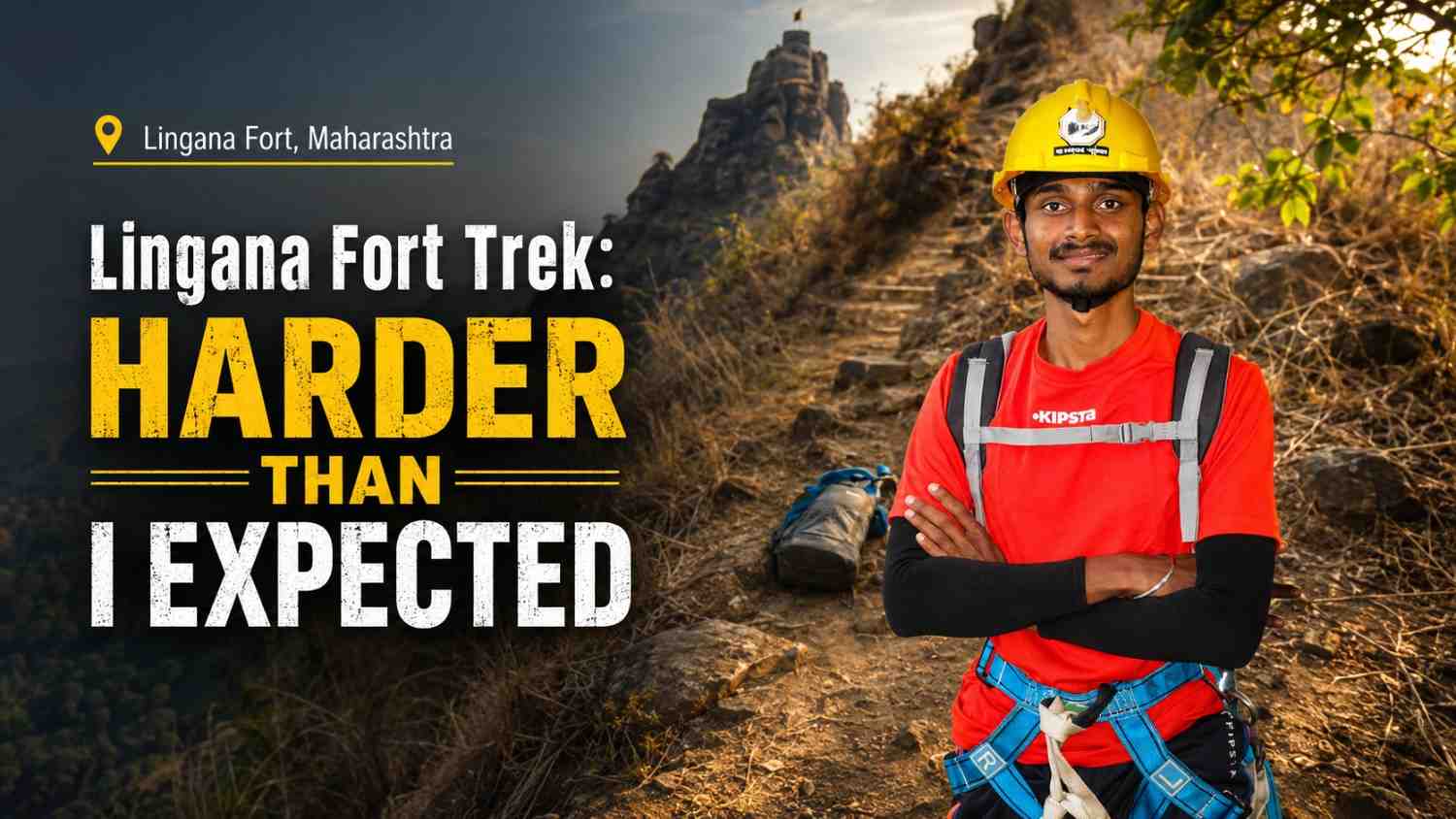
I Tried Lingana Fort Trek—Here’s What Happened
Lingana Fort was not simply another weekend trek for me. It was the first journey that tested my confidence, introduced me to climbing and rappelling, and changed the way I thought about travelling after completing my bachelor’s degree.
Maharashtra has hundreds of trekking routes, especially around Pune, but Lingana is different. It is a steep, exposed pinnacle in the Sahyadri range where reaching the summit requires ropes, climbing equipment, trained leaders and strong physical endurance.
This was also the trip that made me decide something important:
If my friends were unavailable, I would no longer cancel my travel plans. I would travel solo or join a responsible trekking group.
Lingana Fort Trek Quick Information
| Information | Details |
| Place | Lingana Fort |
| Location | Sahyadri range, between Raigad and Torna forts |
| District | Raigad district, Maharashtra |
| Taluka | Mahad Taluka |
| Approximate elevation | 2,969 feet |
| Fort type | Hill fort and technical rock pinnacle |
| Trek difficulty | Difficult and technical |
| Main activities | Trekking, rock climbing and rappelling |
| Common approach villages | Mohari village |
| Suitable for beginners | Only with proper fitness, equipment and an experienced technical team |
| Best season | Generally November to February |
| Avoid | Heavy rain, thunderstorms and attempting without trained leaders |
| Time required | Usually a full-day or overnight expedition, depending on the route |
| My pickup point | City Pride near Swargate, Pune |
| Package cost during my trip | Approximately ₹1,800–₹2,200 |
| Included in my package | Pickup from City Pride, transport to the base village, return drop at Swargate and one breakfast |
| Map | Lingana Fort location |
Package prices, access conditions, equipment, trek schedules and local restrictions can change. Confirm everything directly with your organiser before paying.
Where Is Lingana Fort Located?
Lingana Fort is located in Mahad Taluka of Raigad district, Maharashtra. It rises from the main Sahyadri range between the historically important Raigad and Torna forts.
The fort’s administrative location is in Raigad district, even though many expeditions begin from the Pune side through Velhe, Mohari and Rayling Plateau.
There are two commonly discussed approaches:
- The Konkan-side route through Pane or Panne village
- The Pune-side route through Velhe, Mohari village and Rayling Plateau
My trekking group approached Lingana from the Mohari village side.
Is Lingana Fort a Normal Trek?
No. Lingana Fort should not be treated like a regular marked hill-fort trek near Pune.
A normal trek usually involves walking along a trail, climbing stone steps or crossing a few manageable rocky sections. Lingana includes exposed rock patches where participants may need fixed ropes, climbing harnesses, carabiners, helmets and rappelling equipment.
Some routes involve descending through steep gullies before reaching the base of the pinnacle. The summit section then becomes a climb.
The exact climbing and rappelling distance differs according to the selected route and the points where an organiser fixes ropes. However, established trek documentation, describes long climbing and rappelling sections.
This trek should never be attempted alone or without an experienced technical team.
My Life After Completing Engineering
I was living in Wagholi, Pune when I completed my bachelor’s degree.
After graduation, everyone’s life suddenly started moving in different directions. Some of my friends returned to their hometowns, while others became busy attending job interviews and deciding what to do next.
I also started thinking seriously about my future.
For years, my life had followed the same pattern: study, prepare for examinations, complete the next course and repeat everything again.
In the 10th standard, I told myself that I would travel after completing school.
After that, I joined a diploma course.
During my diploma, I again thought that I would finally start travelling after completing it. However, I soon took admission into an engineering degree.
Three years passed almost in the blink of an eye.
Most of my time was spent sitting in the hostel, attending classes, preparing for examinations and following the same routine. I never properly explored Maharashtra, even though I was studying in a state filled with beautiful forts, mountains and trekking trails.
After completing my degree, I decided to give at least six months to myself.
I wanted to explore Maharashtra, complete challenging treks and experience the freedom I had postponed for years.
My Cancelled Rishikesh Plan
My first plan was to visit Rishikesh with my friends.
I was excited because Rishikesh offered the kind of adventure I wanted. Unfortunately, the group plan was cancelled.
Earlier, a cancelled plan would probably have meant staying in my room and waiting until everyone was free again.
This time, I did not want to repeat that mistake.
I decided that if my friends could not travel, I would join an organised group.
I specifically wanted to experience rope climbing and rappelling. These activities were completely new to me, and I wanted a trip that would genuinely challenge my confidence.
How I Discovered the Lingana Fort Trek?
While researching group trips and adventure activities, I found the Baa_Raigad page on Instagram.
They were organising a Lingana Fort expedition that weekend.
Most people around Pune usually begin with well-known treks such as Sinhagad, Lohagad, Rajgad or Torna. I wanted to choose something less common and more adventurous.
Lingana Fort immediately caught my attention.
It looked raw, steep and difficult. Very few people in my circle had talked about it, which made me even more curious.
The organiser had already mentioned that it was a difficult trek. The warning made it clear that participants needed confidence, stamina and the ability to follow safety instructions.
Instead of making me cancel, the difficulty convinced me to join.
Booking My Trek With the Group
I contacted a member of the Baa_Raigad team and asked about the expedition.
I do not remember the exact amount I paid, but it was approximately ₹1,800–₹2,200 during that period.
The package included:
- Pickup from City Pride near Swargate in Pune
- Transport to the trekking location
- Return drop at Swargate
- One breakfast
- Technical climbing and rappelling equipment
- Assistance from the organising team
The price was based on my trip and should not be considered a current official package rate.
Waiting for the Weekend
Once my booking was confirmed, I became extremely excited.
The expedition itself was scheduled for Sunday, but my journey began on Saturday evening because the Baa_Raigad traveller bus was scheduled to leave Pune at night.
I knew this was going to be different from the usual sightseeing trip.
I was not travelling to take a few photos and return. I was going to climb an exposed Sahyadri pinnacle with ropes and experience rappelling for the first time.
The excitement made it difficult to think about anything else.
Leaving My Hostel on Saturday
On Saturday evening, I got ready at my hostel and started travelling towards the group pickup point.
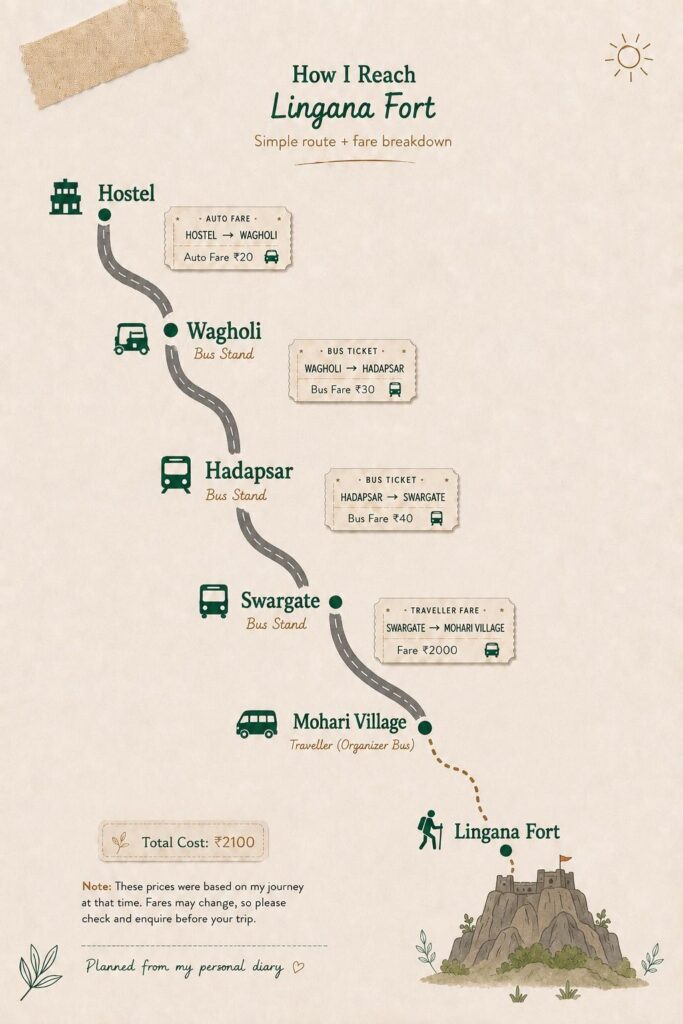
First, I took an auto from my hostel (BJS Phata) to Wagholi.
From Wagholi bus stand, I boarded a PMPML bus to Hadapsar.
From Hadapsar, I continued by bus towards Swargate.
After reaching Swargate, I made my way to City Pride, which was the pickup location given by the Baa_Raigad group.
I did not know anyone in the group. Instead of feeling uncomfortable, I was excited about meeting new people during the journey.
10 PM Departure From City Pride
At around 10:00 PM on Saturday, our traveller bus started from the City Pride pickup point.
Once the journey began, the organisers helped everyone settle in and the group slowly became comfortable with one another.
It was already night, and I knew that by the time we reached the base village, the trekking day would be about to begin.
Even with the long journey ahead, everyone was energetic and excited about Lingana.
The organisers also asked participants to introduce themselves. It was my first time meeting most of the group, so the introductions made the journey feel easier.
Overnight Bus Journey to Mohari Village
I selected a window seat near the back of the traveller bus.
During the journey, people talked, laughed and played antakshari, which slowly turned a group of strangers into trekking companions.
I mostly sat near the window, enjoying the night journey and observing everyone.
We left Pune at around 10:00 PM on Saturday and reached Mohari village at approximately 2:00 AM on Sunday, making the road journey about four hours.
Mohari village was the base village. This is important because Lingana can be approached through different routes, and the base village depends on the organiser and selected route.
Reaching Mohari Village at 2 AM
We reached Mohari village at around 2:00 AM on Sunday.
The bus journey was over, but we still had about two hours before the trek began. That short gap gave us time to prepare ourselves and the equipment for the long day ahead.
At around 4:00 AM, we started trekking from Mohari village towards Lingana.
I do not remember the exact trail distance because I was fully focused on the experience. The difficulty of Lingana also cannot be measured only in kilometres. A short exposed rock patch can require more time and energy than several kilometres of normal walking.
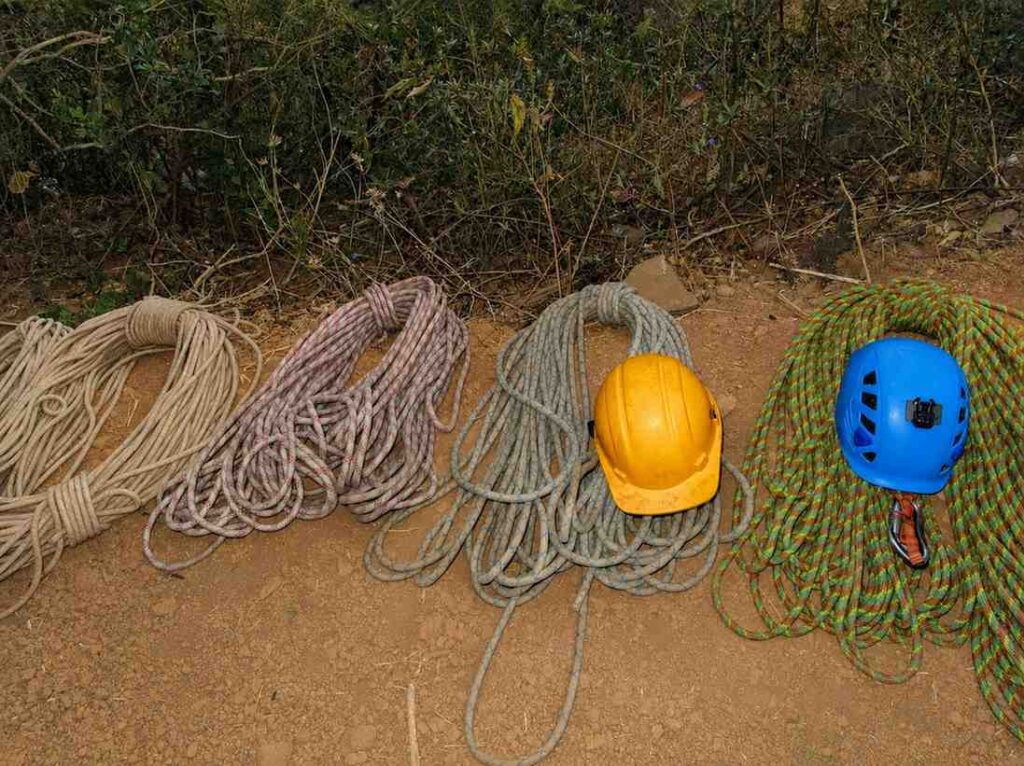
Before the 4:00 AM start, the organising team unloaded and distributed the safety equipment and explained the basic instructions.
Safety Equipment Provided by the Organisers
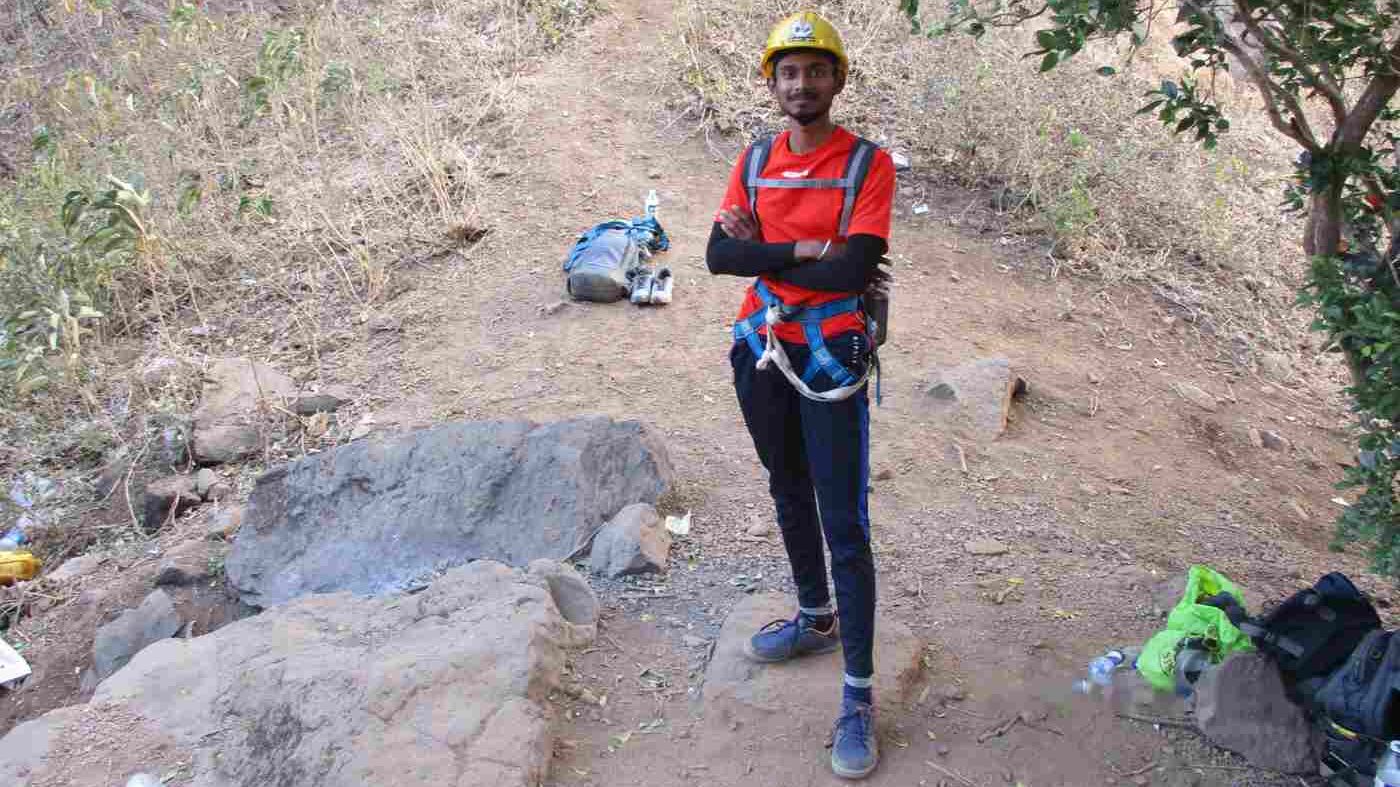
The team gave us protective helmets similar to the helmets commonly used at construction sites. They also brought ropes, safety attachments and other climbing equipment required for the patches.
Before starting, we wore the safety gear and listened to the leaders’ instructions.
The Baa_Raigad team had around five people managing the group during my expedition.
Two of them were extremely skilled climbers.
They moved across difficult sections without depending on the same support rope used by participants. They went ahead, prepared rope anchors and fixed safety lines so that the rest of us could cross the exposed sections.
We were provided with an attachment that had to remain connected to the fixed rope.
This meant that if someone slipped, the safety system could help prevent an uncontrolled fall. However, wearing equipment does not remove every risk. Participants still need to follow instructions, maintain distance and avoid rushing.
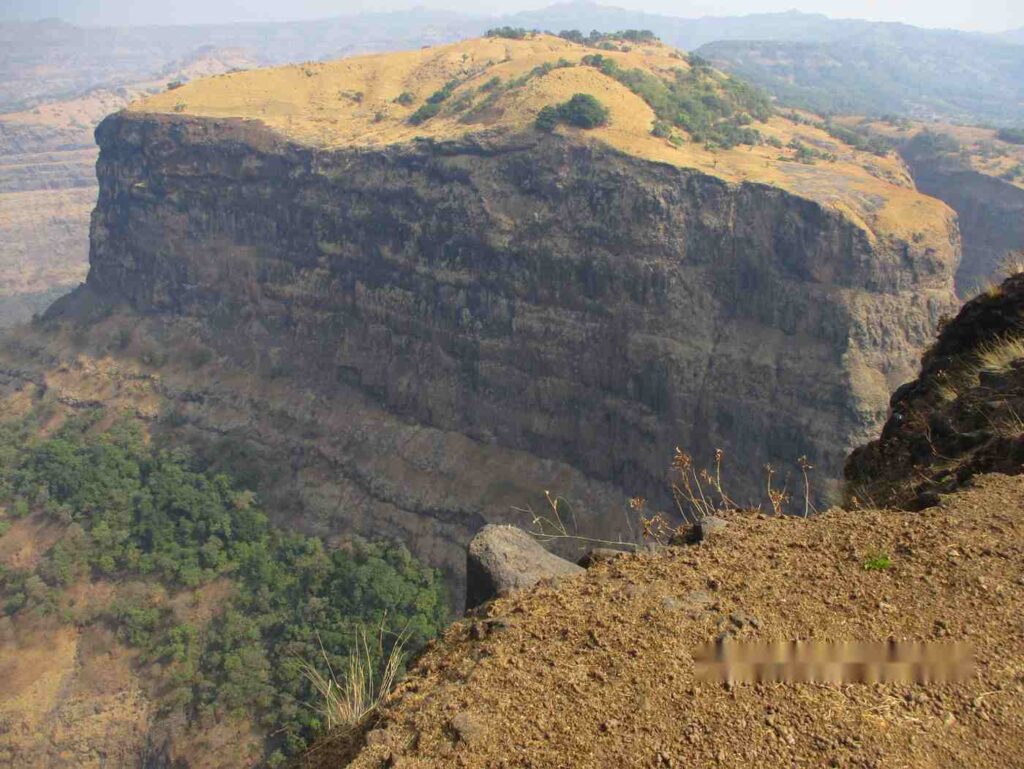
Starting the Lingana Fort Trail
When we started walking from Mohari village at around 4:00 AM, the trail initially felt easy.
The surroundings were beautiful, and everyone still had plenty of energy. For a few moments, it felt like a normal Sahyadri trek.
That feeling did not last long.
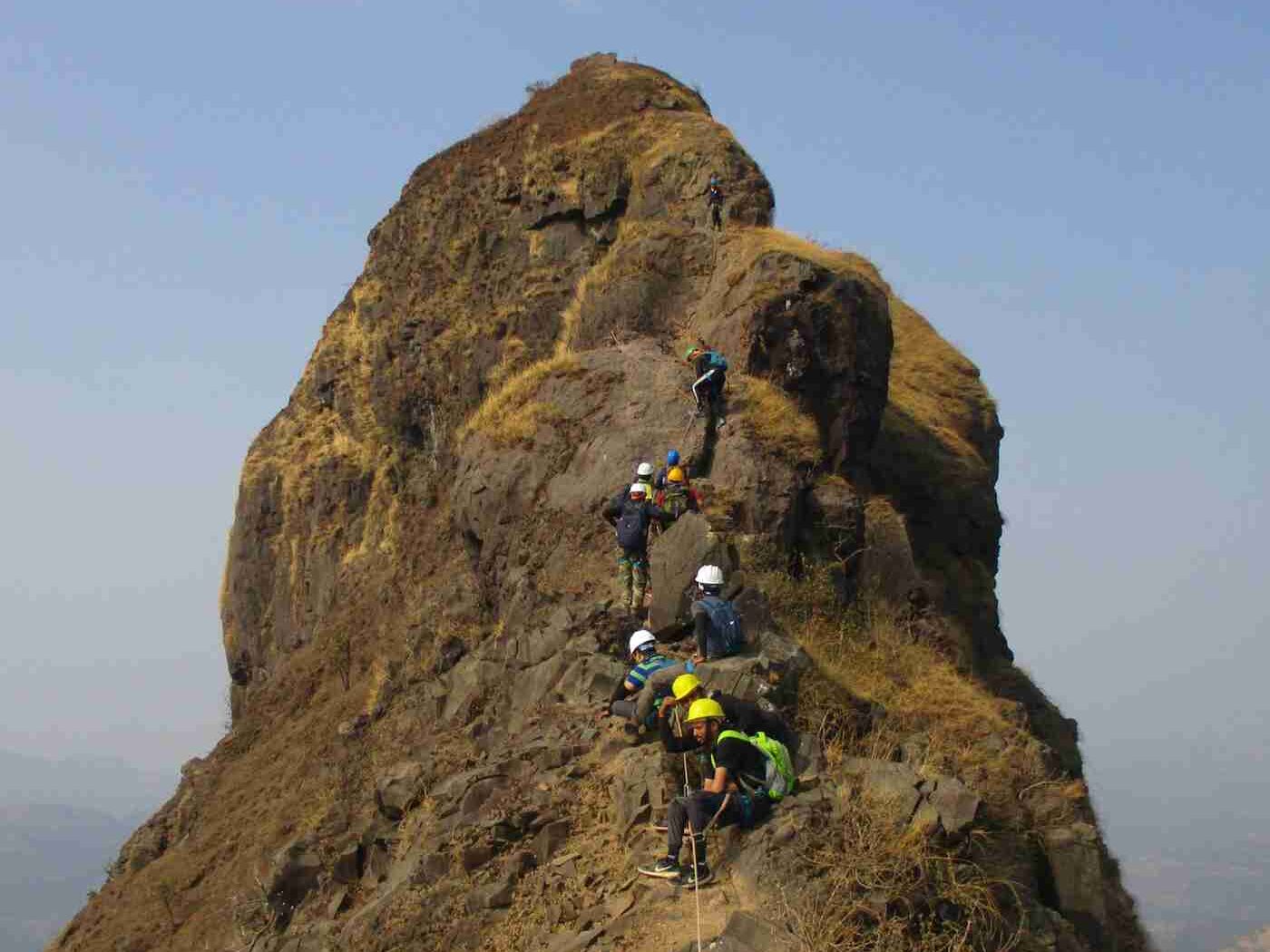
As we continued, the terrain became steeper and more exposed. The forested slopes dropped sharply beside the trail, and the technical nature of Lingana slowly became visible.
Some participants began to realise that the online difficulty warning had been serious.
Our group had started with approximately 20 participants. Even during the earlier sections, a few people decided not to continue.
They understood that the upcoming climb was beyond their comfort or fitness level.
Turning back in a controlled manner with the organisers was a sensible safety decision. On a technical trek, stopping early is always better than freezing on an exposed section where rescuing someone becomes more complicated.
When One Participant Froze on a Steep Patch?
During one steep section, one participant became frightened and stopped in the middle of the route.
The patch was so narrow and exposed that standing comfortably was difficult. She became emotional and said that she wanted to return home.
Because other participants were waiting behind her in a risky area, the situation became tense. One of the instructors spoke loudly and asked her to keep moving.
She still did not feel confident enough to cross alone.
The leader then approached her carefully and guided her out of the difficult section step by step. After reaching a safer point, she decided not to continue further.
The organiser told us that this was only the beginning of the terrain.
After seeing what was ahead, more people chose to return.
Our original group of around 20 participants was reduced to approximately 12. Both men and women stopped during the early sections, which showed that Lingana’s difficulty has nothing to do with gender.
It depends on fitness, preparation, confidence and how a person responds to exposure.
Why I Decided to Continue?
After watching several people turn back, I also understood how serious the trek was.
I was tired, and the most difficult section had not even started.
However, I had joined this expedition because I wanted to test myself.
For years, I had remained inside the same cycle of classes, examinations and hostel life. This was the first time I was doing something that genuinely frightened and excited me at the same moment.
I did not want to give up easily.
I checked my safety attachment, listened carefully to the instructors and continued towards the main climbing section of Lingana Fort.
The real test was about to begin.
Reaching the Main Section of Lingana Fort
After crossing the initial steep patches, we slowly moved closer to the main climbing section of Lingana Fort.
This was the point where the trek changed completely.
Until then, we had been walking, balancing on narrow trails and using fixed ropes for support. The section in front of us looked more like a rock-climbing route than a normal trekking path.
The rock face was steep, exposed and intimidating.
There were no comfortable steps or wide trails. Every movement had to be made carefully while remaining attached to the safety rope.
The organisers went ahead and prepared the climbing route. They checked the anchors, fixed the ropes and instructed us about where to place our hands and feet.
At that moment, I understood why Lingana Fort is considered one of the most difficult treks in Maharashtra.
Following the Organisers’ Safety Instructions
Before allowing us to move forward, the instructors again explained how to use the safety system.
We had to keep our safety attachment connected to the fixed rope while crossing the exposed sections. Whenever we reached an anchor point, we had to transfer the attachment carefully without remaining unsecured.
The leaders instructed us to maintain enough distance between participants.
If one person moved too close to another, both could lose balance or create unnecessary tension on the rope.
We were also told not to overtake, rush or make sudden movements.
During a trek, strength alone is not enough. You need patience, balance and the ability to follow instructions even when your body is tired.
I watched the person in front of me carefully and repeated the same movements.
Some places had small natural gaps where I could place my foot. In other places, I had to hold the rope firmly and search for a stable position on the rock.
Looking down was enough to make anyone nervous.
I tried to keep my attention on the next step instead of thinking about the complete climb.
Climbing One Difficult Patch at a Time
The higher we moved, the more difficult the route became.
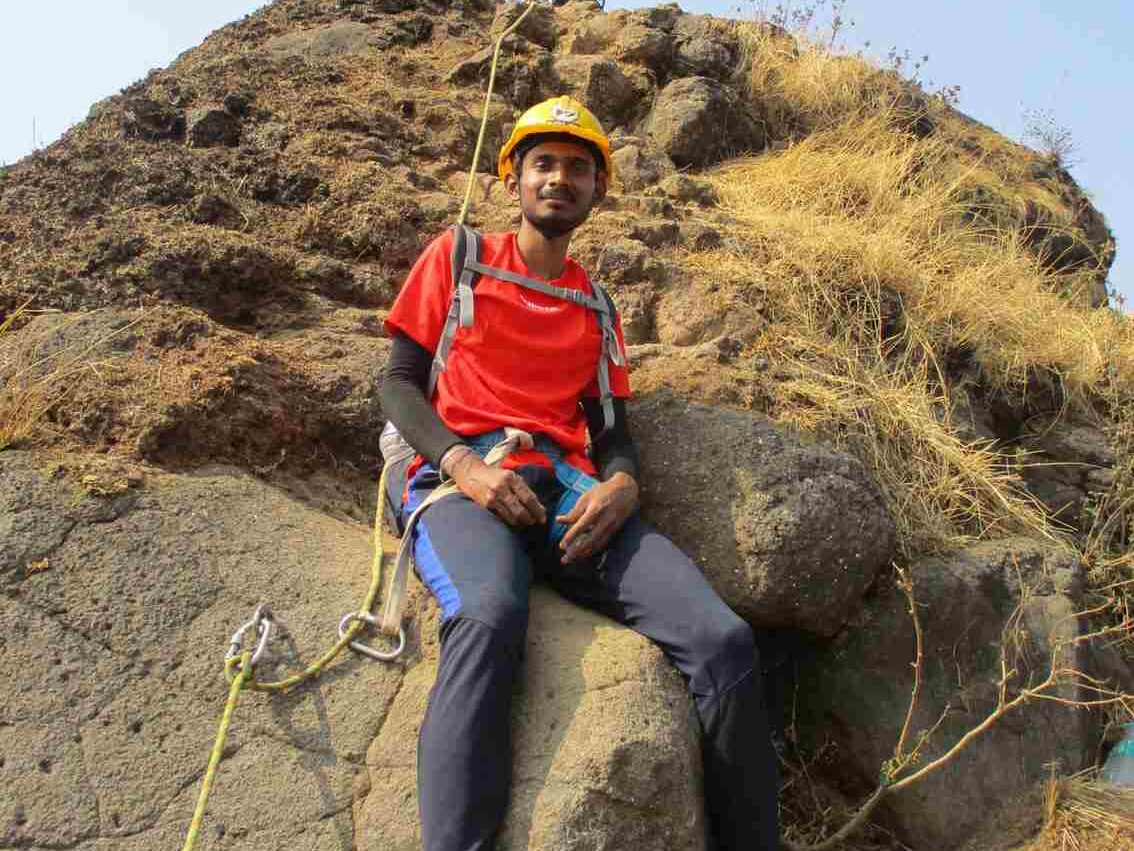
At several points, I had to pull my body upward using both my hands and legs. The helmet, harness and other safety equipment added extra weight, but I was thankful to have them.
My arms slowly started feeling tired.
My legs were also beginning to lose energy after the long journey from Pune and the approach trek from Pane village.
However, I did not want to stop in the middle of an exposed patch.
Whenever I reached a comparatively safe place, I took a few breaths, relaxed my hands and waited for the person ahead to move.
The organisers continued encouraging and guiding us..
Fear Was Present, but I Continued
I would be lying if I said I was not afraid.
There were moments when I questioned whether I had chosen a trek that was too difficult for my first climbing experience.
The rock face was steep, the drop was exposed and my body was already becoming tired.
But I also felt something that I had not experienced during my college years.
I felt completely alive.
For the first time, my mind was not thinking about examinations, marks, interviews or what I needed to do next in life.
I was only thinking about my next handhold and my next step.
That complete concentration helped me continue.
Instead of worrying about how much of the climb remained, I focused on crossing one patch at a time.
Reaching the Top of Lingana Fort
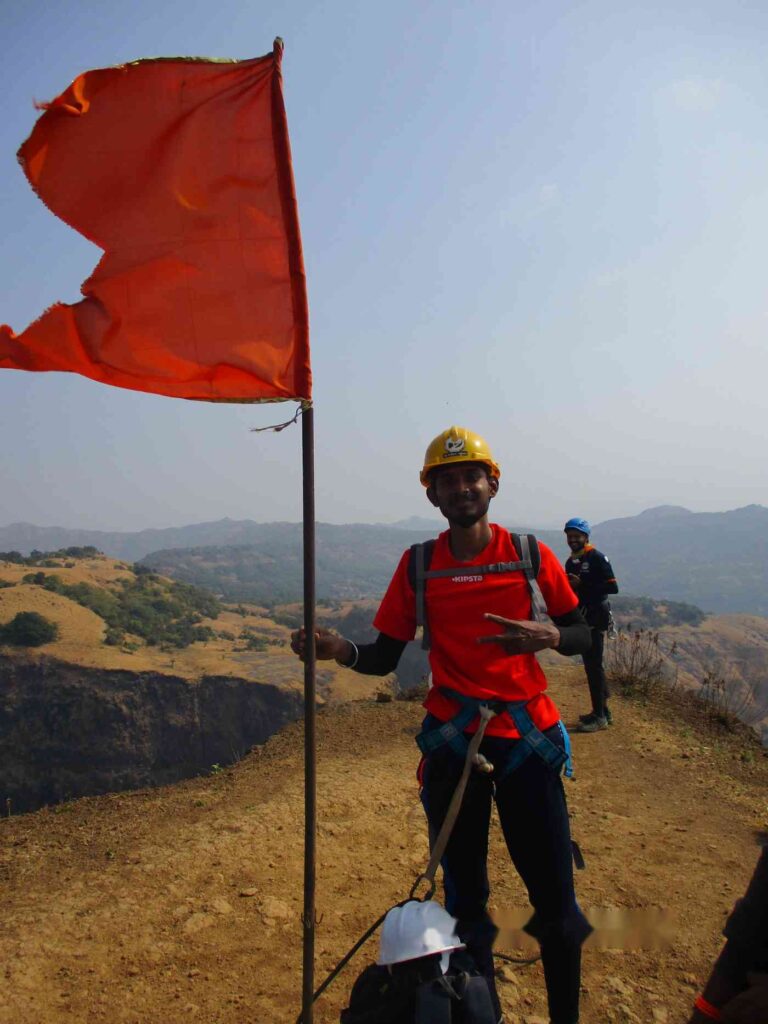
After a long and exhausting climb, I finally reached the top of the Lingana pinnacle at around 10:00 AM on Sunday.
It was difficult to believe that I had actually completed it.
We had started with approximately 20 participants, but only around eight people reached the top during my expedition. Most of those who completed the climb were members of the organising team.
I was one of the few participants who managed to reach the final section.
Standing there gave me a feeling that I cannot properly explain.
It was not only happiness about reaching the top of a fort.
It felt like I had proved something to myself.
I had spent years believing that travel required friends, a perfect plan and enough free time. I had also remained inside the same education cycle for most of my life.
On Lingana, I understood that I was capable of making my own decision, joining an unfamiliar group and completing something that genuinely scared me.
Moment That Changed My Confidence
We spent only a short time at the top because the summit was only half of the expedition. A long technical descent, rappelling and return trek to Mohari village were still ahead of us.
Still, those few minutes became one of the most important moments of my journey.
The surrounding Sahyadri landscape looked completely different from the height of Lingana. The valleys, rocky mountains and forested slopes made me realise how much of Maharashtra I had never explored.
Until that weekend, I had mainly known Pune through college, hostel life and regular routines.
Now I was standing on one of Maharashtra’s most challenging rock pinnacles.
I felt as if I had discovered a completely different version of myself.
This trek was not about competing with the participants who had turned back. Stopping when someone feels unsafe is always a responsible decision on a technical route.
For me, the achievement was personal.
I had wanted to test my confidence, and I had done exactly that.
My First Rappelling Experience at Lingana Fort
I had specifically joined the Lingana Fort expedition because I wanted to experience rope climbing and rappelling.
Now the moment had arrived.
This was my first time rappelling from such a steep height.
The organisers connected my harness to the rope and explained how I needed to position my body. I had to lean backwards, keep my feet against the rock and control the descent without losing balance.
The idea sounded simple while listening to the instructions.
Actually doing it was completely different.
When I looked down, I became nervous.
The normal trekking trail was not available on that section. Rappelling was the practical way to descend the steep rock face.
I had to trust the rope, the equipment and the people managing the safety system.
Taking My First Step Backwards
The first backward step was the most difficult.
My mind was telling me not to lean away from the rock, while the instructor was asking me to trust the harness and maintain the correct position.
Slowly, I shifted my weight backwards.
For the first few moments, my movements were uncomfortable. I held the rope too tightly and used more energy than necessary.
The instructor continued giving directions.
After moving down a little, I began to understand the basic rhythm.
I lowered myself slowly, placed both feet against the rock and continued one controlled step at a time.
The experience was frightening, but it was also exactly the kind of adventure I had wanted.
Cramps During the Rappelling Descent
After some time, the physical strain started affecting my body.
My hands became tired from holding and controlling the rope. My legs were already exhausted from climbing, and they now had to support my body against the rock during the descent.
I started experiencing cramps in both my hands and legs.
Every movement became more difficult.
I could not simply stop for a long time because other participants were waiting above, and the organisers needed to complete the descent before dark.
I tried to remain calm and follow the instructions.
Panicking would only make my body tighter and worsen the cramps.
Slowly and carefully, I continued moving down until I finally reached the end of the rappelling section.
The relief I felt after touching stable ground was unforgettable.
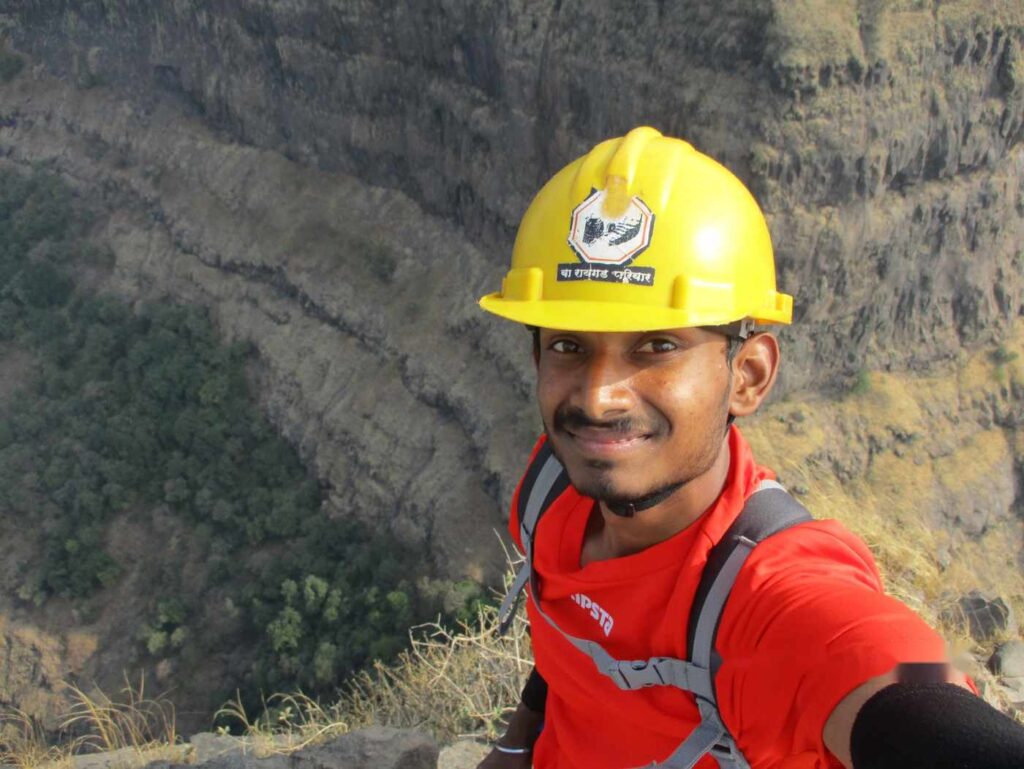
Waiting for the Remaining Participants
After completing my rappelling section, I moved to a safer position and waited.
The other participants descended one by one.
Rappelling takes time because every person must be connected properly, checked by the team and guided down the rock.
No one should be rushed simply because the group is running late.
By this point, everyone was exhausted.
The excitement we had felt during the morning bus journey had been replaced by tired faces, heavy breathing and a strong desire to reach the base camp.
However, our expedition was still not complete.
We needed to collect the equipment and carry it back to Mohari village.
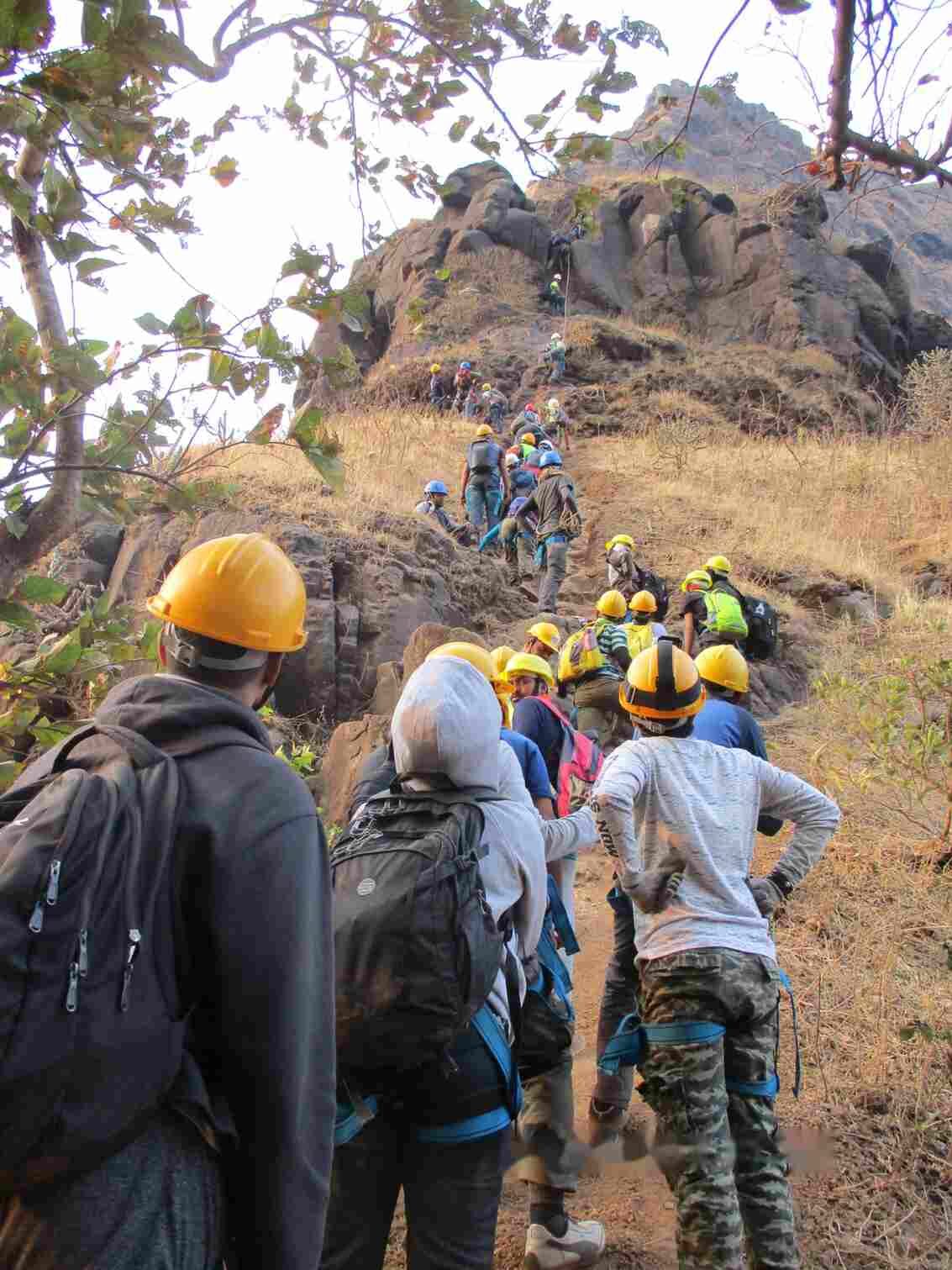
Unexpected Five-Kilogram Rope
Once the rappelling section was completed, the organisers started gathering the ropes and other safety equipment.
The ropes were heavy.
Most members of the organising team were already carrying climbing gear, anchors, helmets and additional ropes. They had spent the entire day fixing safety lines, helping participants and moving repeatedly across difficult sections.
One organiser handed me a coiled rope that weighed approximately five kilograms.
He looked completely exhausted and asked whether I could carry it to the base camp.
I also had very little energy remaining, but I felt bad seeing how much equipment he was already managing.
I agreed to carry the rope.
At that moment, I did not realise how difficult those additional five kilograms would become.
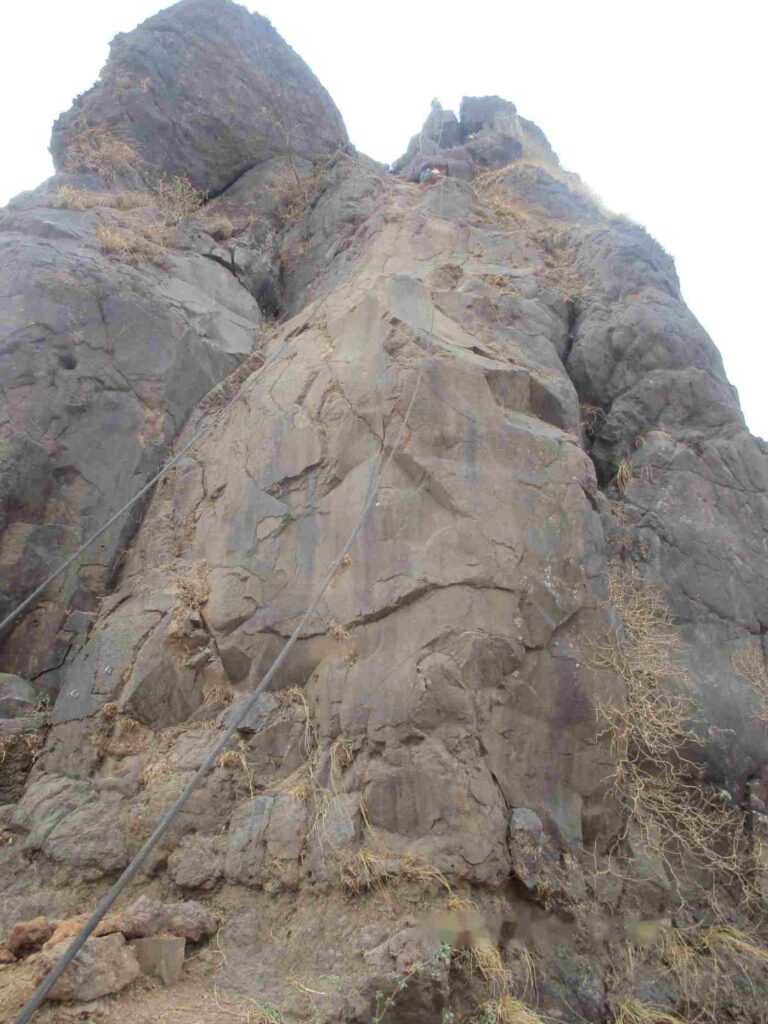
Struggling With the Rope During the Return Trail
I placed the rope on my shoulder and started walking towards the base camp.
For the first few metres, I thought I would manage it.
Soon, the extra weight began affecting my already tired body.
My shoulders started hurting, and the cramps in my legs became worse. Every step felt heavier than the previous one.
The trail was still uneven, and darkness was slowly approaching.
I tried walking faster because I wanted to reach the base camp before it became completely dark. However, my body was no longer allowing me to maintain a normal speed.
After some distance, the cramps became so painful that I had to stop.
Asking Someone to Carry the Rope for a Few Minutes
I asked one of the group members whether he could carry the rope for only a few minutes so that my body could recover.
He said that he could not take it and continued walking.
I then asked one of the instructors for help.
He showed me that he was already carrying another rope and additional equipment. He was also physically exhausted and could not take mine.
At that point, I understood that I had to manage the rope myself.
I sat down and rested for a few minutes.
Sitting provided temporary relief, but whenever I tried to stand again, the cramps returned.
There was no easy solution.
The base camp was still ahead, and the rope had to reach there.
Walking Without Thinking About the Distance
After resting, I lifted the rope again.
This time, I stopped thinking about the remaining distance.
I took a few slow steps and paused.
Then I took a few more steps.
Whenever the cramps became severe, I placed the rope down, waited and started again.
I did not look at the time. I did not count how many kilometres or minutes remained.
My only goal was to keep moving towards the base camp.
That return trail taught me that endurance does not always mean moving quickly.
Sometimes endurance simply means refusing to stop completely.
Finally Reaching Mohari Village Base Camp at 10 PM
After what felt like several hours of descent and return trekking, I finally reached the base camp at Mohari village at around 10:00 PM on Sunday.
The moment I arrived, I handed the rope and safety helmet back to the organisers.
I had almost no energy left.
I slowly drank some water and sat down.
My body was so tired that I did not feel like speaking to anyone. I sat down, drank water and tried to recover while the organisers gathered the group and equipment for the return journey.
By that point, it had been roughly 18 hours since our trek started at 4:00 AM, and all I wanted was to sit quietly and rest.
Once the participants and equipment were accounted for, we prepared to leave Mohari village and return to Pune.
I was relieved that the climbing and trekking part of the expedition was finally complete.
Knowing that the traveller bus was waiting at the base village felt like a reward after such a long day on the mountain.
Everyone Returned Safely
By the time we regrouped at Mohari, the technical part of the expedition was finally over.
Everyone had returned safely.
That was the most important result of the expedition.
People immediately started discussing the difficulty of the trek.
Several participants complained about the steep terrain, exhaustion and challenging descent. Some said that they would never join a trek like Lingana again.
I completely understood their reaction.
Lingana Fort is physically and mentally demanding. It is not the kind of place someone should visit only because they saw a dramatic photograph or Instagram Reel.
But my thoughts were different.
Even after the cramps, exhaustion and struggle of carrying the rope, I knew that I would choose this kind of adventure again.
The Trek That Broke My Life’s Repeating Loop
For almost 24 years, my life had revolved around education and examinations.
After the 10th standard, I thought I would travel.
Instead, I joined a diploma course.
After completing my diploma, I again thought I would finally explore new places.
Instead, I took admission into an engineering degree.
In the blink of an eye, my degree was also complete.
During those years, I rarely travelled or joined treks. Life felt like a repeating loop in which I was always preparing for the next academic stage.
The Lingana Fort trek broke that loop.
For the first time, I understood the freedom of choosing an experience only because I wanted to do it.
I had joined a group where I did not know anyone, attempted climbing, reached the top, experienced rappelling and pushed myself through painful exhaustion.
It felt as if I had been newly introduced to the world outside classrooms and hostel rooms.
My Decision to Travel Without Waiting for Friends
Before this journey, I often depended on friends when making travel plans.
If they cancelled, the entire trip would usually be cancelled.
The failed Rishikesh plan could have become another reason to remain in my room.
Instead, it led me to Lingana Fort.
That experience taught me one of the most important lessons of my life:
Friends are always welcome on a journey, but their availability should not control every travel plan.
If my friends were free, I would happily travel with them.
If they were unavailable, I would travel solo or join a responsible group.
That single decision later became the foundation of many more journeys.
Silent Return Journey to Pune
After reaching Mohari village base camp at around 10:00 PM and getting the group and equipment ready, we started our return journey to Pune.
The atmosphere was completely different from the Saturday-night onward journey.
During the onward journey, people had introduced themselves, played antakshari and laughed together.
Now almost everyone was silent.
I went to the last seat and sat down.
My complete body was tired, and I could barely keep my eyes open.
Within a few minutes, I fell asleep.
I did not understand what was happening during the return journey. I did not notice the road, the stops or the conversations inside the bus.
It felt as if I closed my eyes near Lingana and opened them again when the bus reached Swargate.
Returning to My Hostel at 1 AM on Monday
The Baa_Raigad traveller bus dropped us at Swargate. From there, I booked an Ola cab back to my hostel.
Even the cab journey felt tiring after spending almost the entire Sunday trekking, climbing and descending.
I finally reached my hostel at around 1:00 AM on Monday. I did not have enough energy to change my clothes or arrange my trekking equipment.
I went directly to the bed and fell asleep in the same clothes.
The next time I woke up, approximately 15 hours had passed.
I woke up mainly because I was hungry.
I ate lunch and then went back to sleep again.
My body needed a long recovery after the climbing, rappelling, cramps and return journey.
By the following day, most of the severe tiredness and body pain had slowly disappeared.
The exhaustion was temporary, but the confidence I gained from Lingana remained with me.
What Lingana Fort Gave Me?
Lingana Fort gave me much more than my first rock-climbing and rappelling experience.
It showed me that I did not need to wait for the perfect travel partner or the perfect moment.
It gave me the confidence to meet unknown people, trust a trained team and face a challenge that initially appeared beyond my ability.
Most importantly, it taught me that travelling was not a waste of time after graduation.
It was a way to understand myself.
I returned to Pune with painful muscles, dirty clothes and an exhausted body.
But mentally, I felt lighter and more confident than before.
The practical difficulties of Lingana were real. The exposed sections, physical exhaustion, cramps and descent should never be underestimated.
Still, this journey became the beginning of a new phase in my life.
The student who had spent years postponing travel had finally taken his first serious step into adventure.
History of Lingana Fort
After completing the climb, I became curious about the history of Lingana Fort.
Lingana is not a fort with large gateways, palaces and wide walking paths. It is a steep rock pinnacle in the Sahyadri range between Raigad Fort and Torna Fort.
The pinnacle rises to approximately 2,969 feet above sea level and is located in Mahad Taluka of Raigad district, Maharashtra.
Historical accounts state that Chhatrapati Shivaji Maharaj built Lingana Fort around 1648 to strengthen control over the central Konkan region.
Its strategic position between Raigad and Torna made it useful for observing and controlling movement through the surrounding valleys.
The fort was also used as a prison during the Maratha period.
Its isolated location, steep rock walls and difficult approach made escape almost impossible. Prisoners were reportedly kept inside rock-cut chambers on the fort.
The British captured Lingana in 1818 during their campaign against the Maratha Empire.
Why Is It Called Lingana Fort?
The name “Lingana” is believed to come from the shape of the rock pinnacle.
When viewed from a distance, its tall and narrow structure resembles a linga.
However, Lingana should not be confused with a temple destination.
It is primarily a historical fort, natural rock pinnacle and climbing location. Its name has a spiritual association through its shape, but people mainly visit it for history, trekking, climbing, rappelling and Sahyadri views.
What Remains at the Top of Lingana Fort?
Visitors should not expect a large fort complex like Raigad, Rajgad or Torna.
Most of Lingana’s original fortifications and structures no longer survive in a clearly identifiable condition.
Historical descriptions mention traces of:
- Rock-cut water cisterns
- Storage areas
- Caves or chambers
- A grain storage structure
- Old rock-cut steps
Many of the original steps and accessible routes were destroyed or became unusable over time. This is one reason why reaching the summit now requires technical climbing equipment.
For me, Lingana’s importance was not based on the number of structures remaining at the top.
Its isolated location, difficult approach and natural defensive shape helped me understand why it was once considered almost inaccessible.
Lingana Fort Trek Difficulty
Lingana Fort is a difficult trek.
It should not be compared with regular beginner treks around Pune.
The complete expedition may involve:
- Long approach trails
- Narrow exposed sections
- Steep ascents and descents
- Rock climbing with ropes
- Rappelling
- Loose stones
- Deep valleys
- Limited resting space
- Carrying personal or group equipment
- Several hours of continuous physical activity
The documented Lingana–Raigad route includes approximately 1,000 feet of climbing and around 700 feet of rappelling, although the exact distance depends on the selected route and rope setup.
My cramps during the descent showed me that reaching the top is only half of the journey.
You must preserve enough energy for rappelling, returning to the base village and handling unexpected situations.
Lingana Fort Timings
Lingana Fort does not operate like a normal tourist monument with a ticket counter and fixed opening hours.
The expedition timing depends on:
- The selected approach route
- The trekking organiser
- Weather conditions
- Group size
- Rope-fixing time
- Participant experience
- Available daylight
A Lingana expedition should begin early because climbing and rappelling can take several hours.
Our delayed departure from Shaniwar Wada reduced the daylight available for the return journey. By the time we started descending, everyone was already concerned about reaching the base before darkness.
Current access conditions or local restrictions may change. Confirm the complete schedule with your organiser before travelling.
Best Time to Visit Lingana Fort
The most suitable period for a Lingana fort is generally from November to February.
During winter, the weather is comparatively cooler, visibility is often better and the rock surface is more likely to remain dry.
October to February
This is generally the preferred period for organised climbing expeditions.
Post-monsoon greenery may still be visible in October, while November to February usually offers more comfortable daytime temperatures.
March to May
Summer heat can make the long approach, climbing and return journey extremely exhausting.
If an organiser conducts an expedition during this period, ask about the starting time, water availability and heat-management plan.
June to September
Heavy monsoon conditions can make the rocks, exposed sections and surrounding trails extremely slippery.
Rain, fog, strong wind and poor visibility can increase the danger significantly. Summit attempts should not be made during unsafe weather.
The final decision should always belong to experienced leaders who understand the route and current conditions.
How to Avoid Cramps During the Trek?
Cramps became one of the hardest parts of my return journey.
A few practical precautions may help:
- Hydrate properly before the trek
- Carry electrolytes
- Eat a proper meal before starting
- Do not depend only on sugary snacks
- Stretch your calves, thighs and shoulders
- Maintain a steady pace
- Do not rush to match experienced climbers
- Inform the leader immediately if cramps begin
- Avoid carrying additional heavy equipment when completely exhausted
- Rest only at a safe location selected by the leader
Do not ignore severe cramps, dizziness, chest pain, breathing difficulty or confusion.
Tell the organiser immediately instead of trying to hide the problem.
Nearby Places to Visit Around Lingana Fort
Lingana is already a complete and exhausting expedition. I would not recommend adding another demanding trek on the same day.
These nearby places are better covered on a separate day.
Raigad Fort
Raigad Fort was the capital of Chhatrapati Shivaji Maharaj’s kingdom and is one of Maharashtra’s most historically important forts.
It is a much better choice for travellers who want Maratha history without attempting Lingana’s climb.
Raigad and Lingana are geographically connected through the Sahyadri landscape, but road access between individual base points can take longer than expected.
Torna Fort
Torna Fort is located on the Pune side of the Sahyadri range.
It is historically important and offers a demanding but non-technical trekking experience compared with Lingana’s summit climb.
Torna should be planned as a separate trek because combining it with Lingana requires a specialised multi-day expedition.
Estimated Lingana Fort Trek Budget From Pune
My organiser charged approximately ₹1,800–₹2,200 during my trip.
A present-day personal estimate can be planned as follows:
| Expense | Estimated cost |
| Organised trek package | ₹2,000 or more |
| Travel to and from swargate pickup point | ₹200 |
| Additional food | ₹300 |
| Water and electrolytes | ₹100 |
| Estimated total | ₹2600 |
This is only a planning estimate.
If climbing equipment, transport, insurance, accommodation or meals are not included, the total can be higher.
My Honest Review of Lingana Fort
Lingana Fort was physically one of the hardest experiences of my early travelling life.
The climbing was difficult.
The rappelling was frightening.
The cramps during the descent became painful, and carrying the heavy rope towards the base camp tested whatever energy remained in my body.
Even though I reached the top at around 10:00 AM, the descent, rappelling and return trail continued for many more hours, and I did not reach Mohari village base camp until about 10:00 PM.
Despite all these difficulties, I do not regret joining the expedition.
Reaching the top was not the only achievement.
The bigger achievement was discovering that I could travel without waiting for my friends, join a group of unknown people and face an adventure outside my normal life.
However, I would never recommend Lingana casually.
Someone should not book this trek only after watching a dramatic Instagram Reel.
Understand the risks, improve your fitness, examine the organiser carefully and be mentally prepared to turn back if the leaders consider it unsafe.
Final Thoughts
Lingana Fort was the trek that broke the repeating loop of my life.
For years, I postponed travelling.
After the 10th standard, I thought I would travel after completing my diploma.
After my diploma, I thought I would travel after engineering.
Then engineering also ended, and I realised that waiting for the perfect time could continue forever.
My cancelled Rishikesh plan could have become one more excuse.
Instead, it took me towards Lingana.
I reached the top with only a small number of participants, experienced rappelling for the first time and returned to the base camp after one of the most exhausting walks of my life.
When I finally reached my hostel at around 1:00 AM on Monday, I fell asleep without even changing my clothes.
My body needed almost two days to feel normal again.
But mentally, something had permanently changed.
I no longer wanted my travel plans to depend completely on other people.
If friends joined, I would happily travel with them.
If they cancelled, I would travel solo or join a responsible group.
Lingana Fort gave me pain, exhaustion, fear and cramps.
It also gave me freedom, confidence and a new direction.
That is why Lingana will always remain more than a fort trek for me.
It was the place where my real travelling journey started.
Frequently Asked Questions
What is the height of Lingana Fort?
Lingana is commonly recorded as approximately 2,969 feet above sea level.
Its exposed rock pinnacle makes it appear more dramatic than the elevation number alone suggests.
Who built Lingana Fort?
Historical accounts state that Chhatrapati Shivaji Maharaj built Lingana Fort around 1648 after gaining control of the surrounding region.
Why was Lingana Fort built?
Lingana helped strengthen Maratha control over the central Konkan region.
Its position between Raigad and Torna gave it strategic importance.
Is the Lingana Fort trek difficult?
Yes. Lingana is considered a difficult and expedition involving exposed terrain, rope climbing and rappelling.
Can beginners attempt Lingana Fort?
A beginner should attempt it only if accepted by an experienced technical organiser after understanding their fitness and comfort level.
It should not be selected as a first trek without preparation.
Can Lingana Fort be attempted solo?
No.
The summit route should not be attempted alone. Technical equipment, trained climbers, reliable anchors and emergency support are necessary.
Can women complete the Lingana Fort trek?
Yes. Trekking ability is determined by fitness, preparation, confidence and technical guidance—not gender.
Every participant should be assessed according to the same safety requirements.

Solo traveller, biker, and explorer sharing honest travel guides, hidden places, and unforgettable road trips across India.