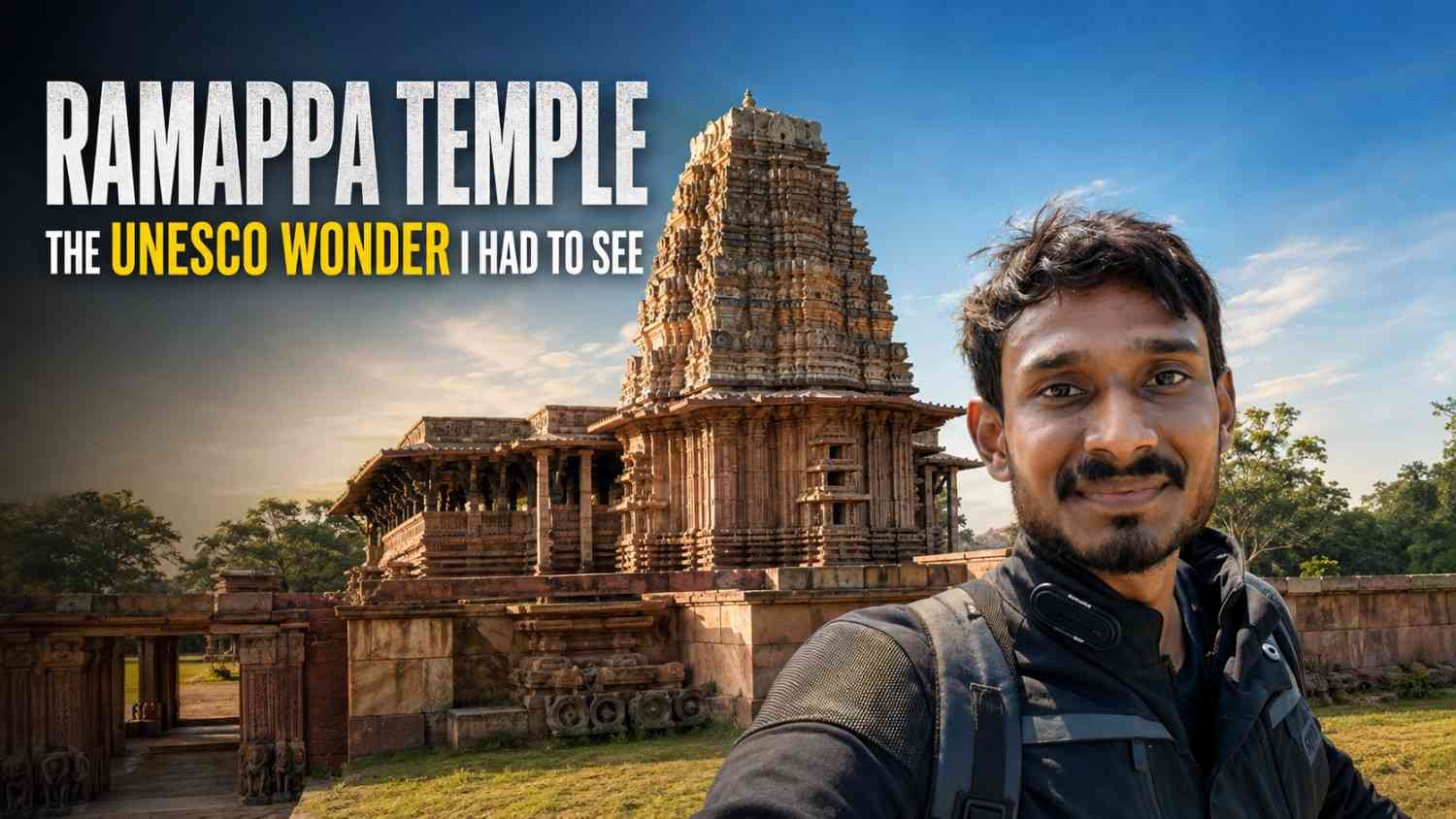
What I Found After Riding 108 KM to Ramappa Temple?
Ramappa Temple had been appearing in my travel plans for a long time, but an Instagram reel finally convinced me to visit this architectural wonder. Located around 108 km from Karimnagar, this UNESCO World Heritage Site looked perfect for another peaceful weekend bike ride through Telangana.
The official name of the monument is the Kakatiya Rudreshwara (Ramappa) Temple. It is also known as the Ramalingeshwara Temple because the main shrine is dedicated to Lord Shiva. Although many travellers search for “Ramappa Temple in Warangal,” the temple is now located in Palampet village of Mulugu district, Telangana.
This trip gave me everything I enjoy about weekend travel: a morning bike ride, a powerful Shiva darshan, beautiful Kakatiya carvings, peaceful surroundings and an unexpected stop at Ramappa Lake.
Ramappa Temple Quick Information
| Information | Details |
| Place | Ramappa Temple |
| Official name | Kakatiya Rudreshwara Temple |
| Also known as | Ramalingeshwara Temple |
| Location | Palampet village, Venkatapur Mandal |
| District | Mulugu district, Telangana |
| Main deity | Lord Shiva |
| Construction started | 1213 CE |
| Dynasty | Kakatiya dynasty |
| UNESCO status | Inscribed in 2021 |
| Distance from Karimnagar | 108km |
| Distance from Warangal | Approximately 67–75km |
| Temple timings | Commonly listed as 6:00 AM to 6:00 PM |
| Entry fee | Free during my visit |
| Parking fee | Free during my visit |
| Shoe stand | Free during my visit |
| Washroom charge | ₹5 during my visit |
| Photography | Generally permitted; avoid flash inside |
| Time required | Around 1–2 hours |
| Best time to visit | October to March |
| Nearby attraction | Ramappa Lake, approximately 1.2 km away |
| Map | Ramappa Temple location |
Visitor charges and timings can change, so confirm them locally before travelling, especially during festivals and public holidays.
Before planning my ride to Ramappa Temple, I had already explored several beautiful attractions in Warangal, including Warangal Fort, Kush Mahal and Ekashila Gutta.
On another trip, I also visited Bhadrakali Temple, Padmakshi Temple and the Thousand Pillar Temple in a single day. If you are travelling to Ramappa Temple, you can include some of these historical and religious places in your Warangal itinerary.
I have shared my complete experiences, routes and practical tips in my Warangal Fort travel guide and Bhadrakali Temple Warangal guide, which can help you plan a longer trip.
Where Is Ramappa Temple Located?
Ramappa Temple is located in Palampet village in the Venkatapur Mandal of Mulugu district, Telangana.
Many people still call it Warangal Ramappa Temple because Palampet was historically associated with the wider Warangal region. However, its present administrative location is Mulugu district.
The temple is surrounded by agricultural fields, greenery and the historic Ramappa Lake. According to UNESCO, this natural setting was an important part of the original temple design. The Kakatiya builders intentionally connected the religious structure with the surrounding hills, forests, fields and water reservoir.
Why I Planned This Weekend Ride?
As usual, my weekend began with the same question:
Where should I travel from Karimnagar this time?
While scrolling through Instagram reels, a video about Ramappa Temple suddenly appeared. The detailed stone carvings immediately caught my attention. When I searched for more information, I discovered that it was a UNESCO World Heritage Site and only around 108 km from my home in Karimnagar.
That was enough for me to decide my weekend destination.
A 108 km journey meant I could comfortably reach the temple in approximately two hours, spend enough time exploring the complex and return home on the same day.
Once the destination was decided, I started waiting for the weekend.
Preparing My Riding Gear on Friday
On Friday evening, I cleaned my helmet and riding gear. I also checked my intercom, power bank and other essential accessories to ensure everything was fully charged.
This preparation has now become part of every bike trip.
Even when the destination is nearby, I prefer to prepare everything the previous night. It prevents unnecessary delays in the morning and allows me to start the journey without worrying about a discharged device or missing accessory.
I planned to sleep early, but anyone who loves travelling will understand what happened next.
Before a trip, getting proper sleep is difficult.
My mind was filled with different thoughts about Ramappa Temple. I kept imagining its architecture, history and the road ahead. After nearly two hours of thinking about the journey, I finally fell asleep.
Starting My Ride from Karimnagar
I woke up at around 6:00 AM and started getting ready.
After wearing all my riding gear and completing the final checks, I started from Karimnagar at nearly 7:00 AM.
This was slightly late compared with my usual departure time. However, Ramappa Temple was only around 108 km away, and Google Maps showed a journey time of approximately two hours. Therefore, I did not feel the need to start before sunrise.
The weather was pleasant, the morning traffic was manageable and music was playing through my intercom. It felt like a perfect beginning to another one-day bike trip.
Karimnagar to Ramappa Temple Route
The route I followed was:
Karimnagar → Kesavapatnam → Parkal → Ghanpur → Ramappa Temple
This route was approximately 108 km from my starting point and took me nearly two hours.
| Route section | My experience |
| Karimnagar to Kesavapatnam | Good road with some maintenance and widening work |
| Kesavapatnam towards Parkal | Mostly comfortable for riding |
| Parkal road | Good condition, but watch for paddy drying beside the road |
| Ghanpur to Ramappa Temple | Pleasant rural stretch towards Palampet |
| Total travel time | Approximately 2 hours |
Road-condition update
During this ride, some road-widening work was taking place on sections of the Karimnagar–Warangal road. When I travelled on the same side more recently, many sections had become smooth, well-maintained four-lane roads.
However, construction may still continue on a few stretches. Riders should slow down near diversions and unfinished sections.
Another issue I noticed near the Parkal side was paddy being dried along one part of the road. Locally, the paddy is called vadlu in Telugu.
The road itself was good, but riders need to be careful around these areas. Drying grain can reduce the usable road width and may also make the surface risky for two-wheelers if you brake or turn suddenly.
My Peaceful Two-Hour Morning Ride
Once I crossed the busier sections, the ride became calmer.
I continued listening to music and enjoying the morning weather. This is one of my favourite parts of travelling by bike. Even when the destination is only two hours away, the changing roads, villages and landscapes make the journey feel refreshing.
I was not rushing to reach the temple.
The distance was manageable, the road was mostly comfortable and I had enough time to enjoy the ride at my own pace.
After nearly two hours, I finally reached Ramappa Temple in Palampet.
Parking at Ramappa Temple
There was plenty of open ground outside the temple premises for parking both two-wheelers and four-wheelers.
During my visit, parking was completely free.
I parked my bike, locked it properly and placed my helmet on the handle. I also secured the helmet with a separate lock before walking towards the entrance.
Free Shoe Stand Outside the Temple
A shoe stand was available outside the temple entrance.
Nobody charged me for using it during my visit. I left my footwear there and entered the Ramappa Ramalingeshwara Temple complex.
From the moment I saw the main structure properly, I understood why this temple had received worldwide recognition.
Photos and Instagram reels had shown me the building, but they could not capture the quality of its stonework.
The architecture was not simply old or historic. Every section looked like a carefully created piece of art.
My First View of the Temple Architecture
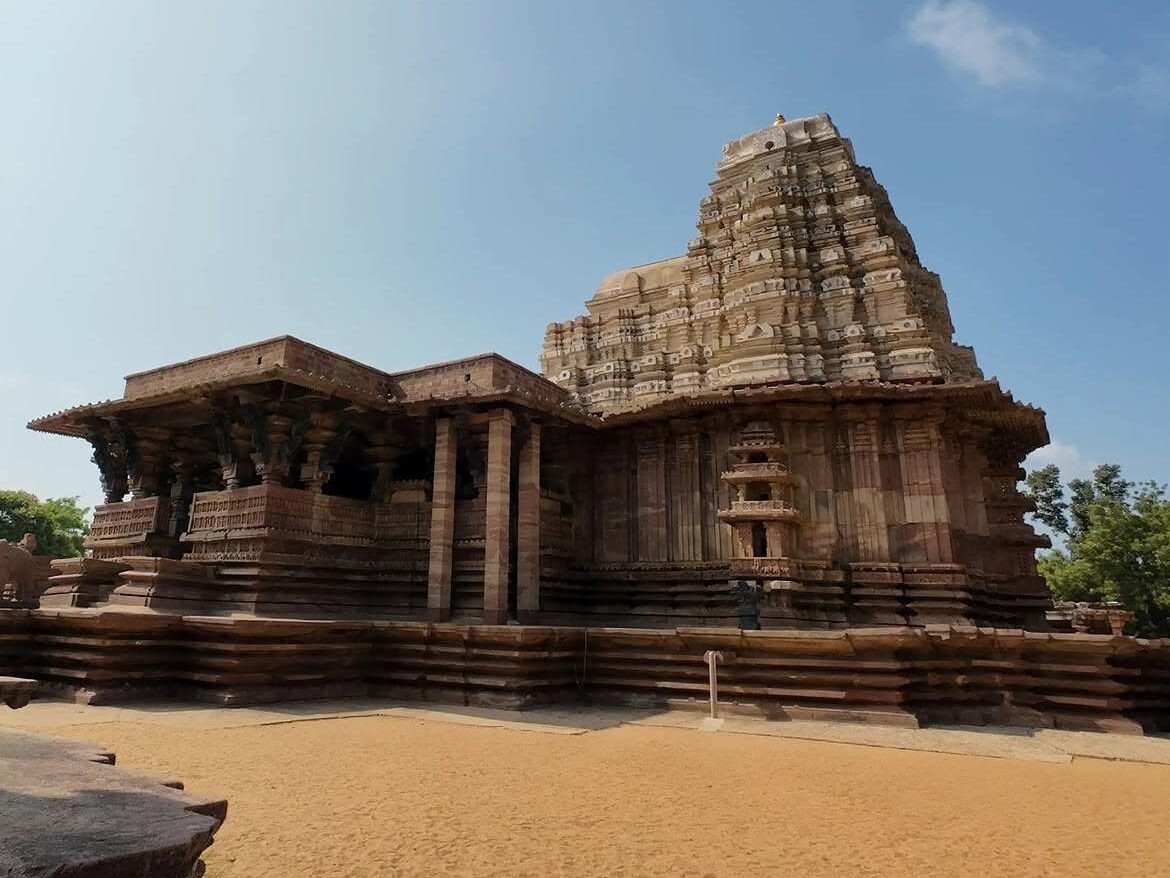
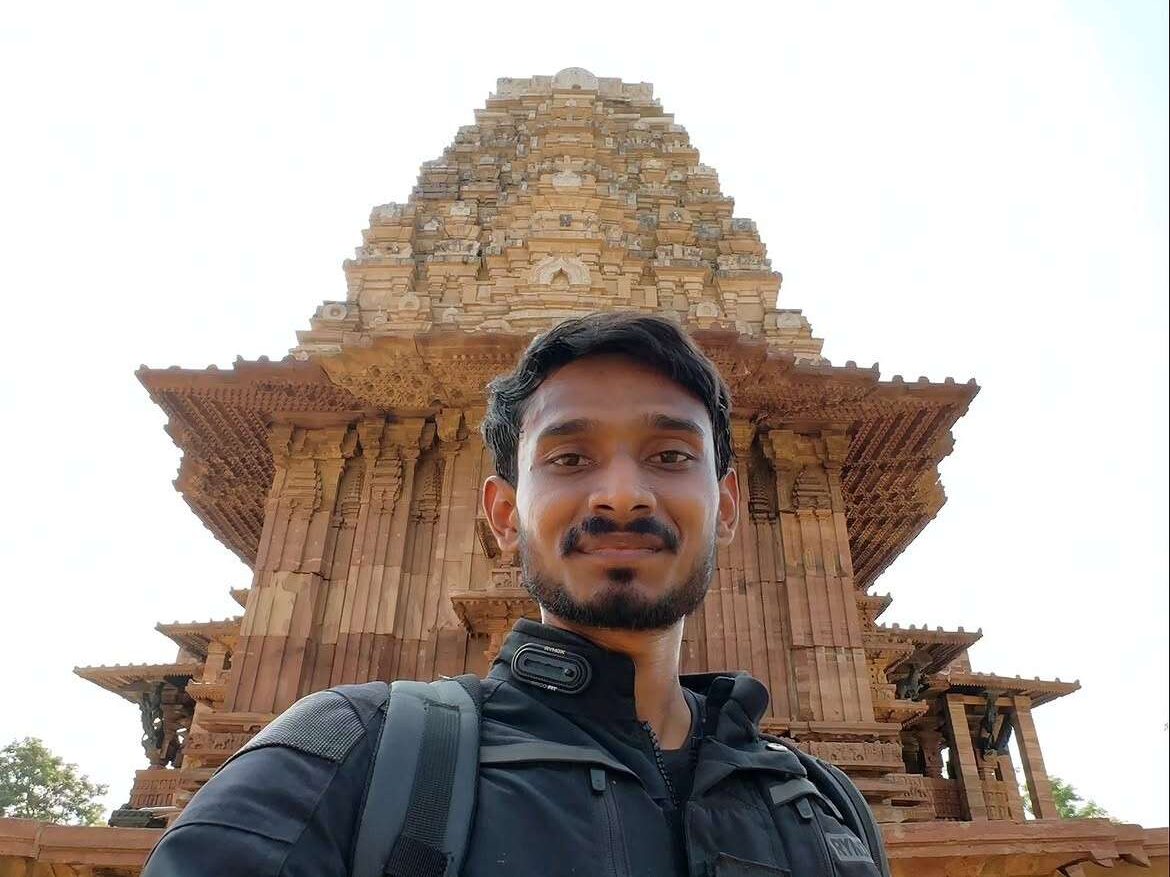
When I walked closer, I found myself staring at the exterior carvings.
The stone karigari was so detailed that I genuinely did not know how to explain it in words. The pillars, walls, figures and decorative patterns showed a level of craftsmanship that needs to be seen in person.
According to UNESCO’s description of Ramappa Temple, construction began in 1213 CE and is believed to have continued for around 40 years. The structure combines sandstone with carved granite and dolerite, while lightweight porous bricks were used in its pyramidal tower.
Standing in front of an achievement created more than 800 years ago felt completely different from seeing Ramappa Temple pictures online.
At that moment, my 108 km ride already felt worthwhile.
Darshan at Ramappa Ramalingeshwara Temple
After admiring the temple from outside, I slowly entered the main shrine for darshan.
Ramappa Temple is dedicated to Lord Shiva, and the Shiva Lingam inside the sanctum is worshipped as Ramalingeshwara Swamy. This is why many devotees also call this place the Ramappa Ramalingeshwara Temple or Ramalingeshwara Temple.
The interior was darker and calmer compared with the bright exterior. After completing the darshan, I stood quietly for a few moments.
It felt peaceful and spiritually different.
I had initially planned this trip after seeing the architecture in an Instagram reel. However, after standing in front of the Shiva Lingam, I understood that Ramappa Temple is not only a historic monument or photography location.
It is still an active place of worship.
People have been offering prayers here for centuries, and that living spiritual connection makes the experience more meaningful.
Beautiful Nandi Statue Opposite the Shiva Lingam
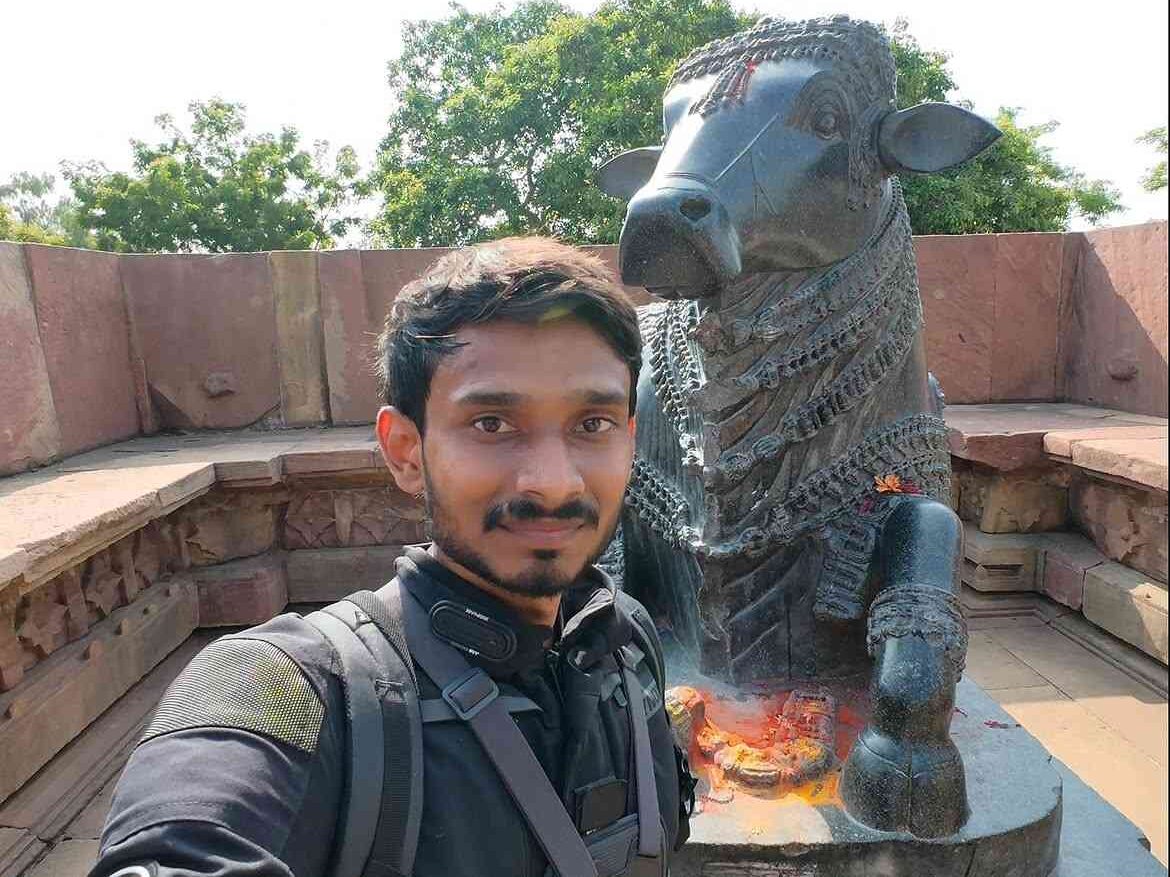
Directly opposite the main shrine, I noticed a large Nandi statue.
Nandi is the sacred bull and vehicle of Lord Shiva. As in most Shiva temples, the statue faces the Shiva Lingam inside the sanctum.
However, this was not an ordinary Nandi sculpture.
The statue was carved from stone with impressive detailing. Even the ornaments, facial features and body shape looked carefully finished. When I looked closely, it was difficult to imagine how artists created such smooth and detailed work using the tools available more than 800 years ago.
This was one of the moments when I stopped looking at the structure simply as a visitor.
I started thinking about the people who designed and carved it.
Creating something like this would be difficult even with modern machines. The Kakatiya sculptors completed it entirely through their knowledge, patience and handwork.
If you visit the temple, do not walk past the Nandi quickly. Spend a few minutes observing the carving from different sides without touching or disturbing it.
Ramappa Temple History
After completing my darshan, I came outside and searched for more information about Ramappa Temple history.
What I discovered made the monument even more impressive.
The official name of the temple is the Kakatiya Rudreshwara Temple, although it is popularly known as Ramappa Temple. Construction began in 1213 CE during the Kakatiya period and is believed to have continued for approximately 40 years.
A historical inscription at the site records that Recharla Rudra began its construction. He was an important military commander and administrator under Kakatiya ruler Ganapati Deva.
The temple is therefore more than 800 years old.
According to the UNESCO World Heritage Centre, the complex represents the artistic, architectural and engineering achievements of the Kakatiya dynasty, which ruled this region between the 12th and 14th centuries.
The temple became a UNESCO World Heritage Site in July 2021 under the official name Kakatiya Rudreshwara (Ramappa) Temple, Telangana.
Why Is It Called Ramappa Temple?
The main shrine is officially known as Rudreshwara Temple and is dedicated to Lord Shiva.
A widely repeated local account says that the temple became popularly known as Ramappa Temple in honour of the artisan or sculptor associated with its construction. This is unusual because most Indian temples are named after the deity worshipped inside them.
Whether visitors call it Ramappa Temple, Rudreshwara Temple or Ramalingeshwara Temple, all these names refer to the same historic Shiva temple at Palampet.
How Ramappa Temple Survived for More Than 800 Years?
The beauty of the Ramappa Kakatiya Ramalingeshwara Rudreshwara Temple is not limited to its sculptures.
Its construction technology is equally impressive.
The Kakatiya builders used a combination of sandstone, granite, dolerite and lightweight porous bricks. The temple was also built using a sandbox foundation technique, in which a carefully prepared mixture beneath the structure helped absorb movement and protect the building.
UNESCO identifies this sandbox foundation and the use of lightweight bricks as important examples of Kakatiya engineering.
These porous bricks are popularly called “floating bricks” because they are much lighter than ordinary building bricks. They were used in the pyramidal vimana, or tower above the sanctum, to reduce pressure on the lower structure.
The temple has survived centuries of changing weather, natural disturbances and human activity. Some portions were damaged over time, but the main shrine and much of its detailed stonework remain standing.
This was one of the biggest surprises for me.
We often imagine ancient builders as people with limited technology. Ramappa Temple proves that they had a deep understanding of materials, weight distribution, foundations and long-lasting construction.
Incredible Kakatiya Stone Carvings
After learning a little about its history, I again started observing the exterior and interior details.
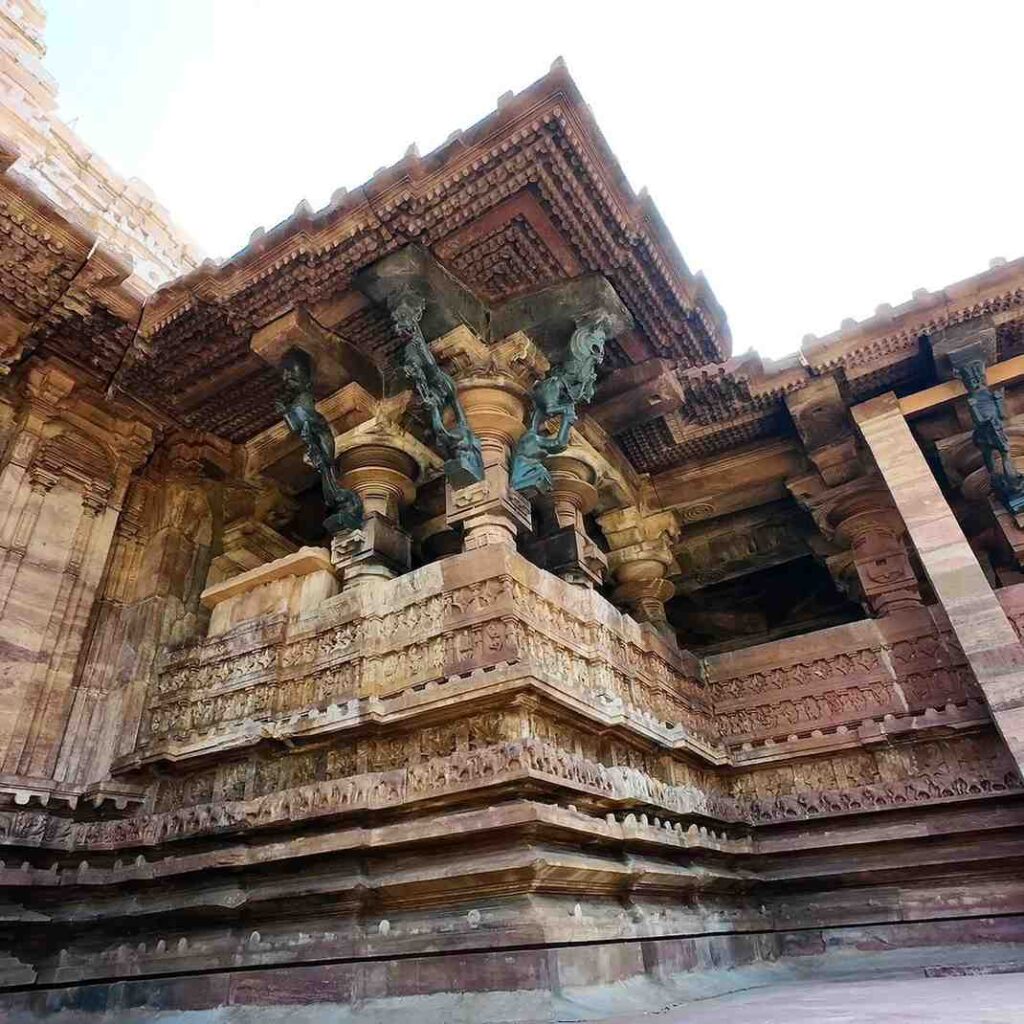
The temple stands on a raised platform and follows a star-shaped plan. Its decorated beams, pillars and bracket figures are among its most recognisable architectural features.
Several sculptures appear to be moving rather than standing still.
Some figures show dancers in expressive poses. Others represent musicians, animals, mythological characters and scenes connected to the lifestyle of the Kakatiya period.
The hard dolerite stone used for many sculptures has a smooth, almost metallic finish. Even after hundreds of years, some carvings continue to retain their shine.
According to UNESCO, these sculptures reflect regional dance traditions and Kakatiya culture. Their sense of movement and fine detailing contributed to the temple’s recognition as a masterpiece of creative and artistic achievement.
I did not have enough knowledge to identify every figure or mythological scene.
Still, I could appreciate the effort behind them.
Every pillar appeared to have its own design. Every corner revealed another carving. Even after walking around the temple more than once, I continued noticing details that I had missed earlier.
This is why I recommend taking a local guide if one is available. A knowledgeable guide can explain the stories behind the sculptures, the construction methods and the different sections of the complex.
Taking Ramappa Temple Photos Without Damaging the Monument
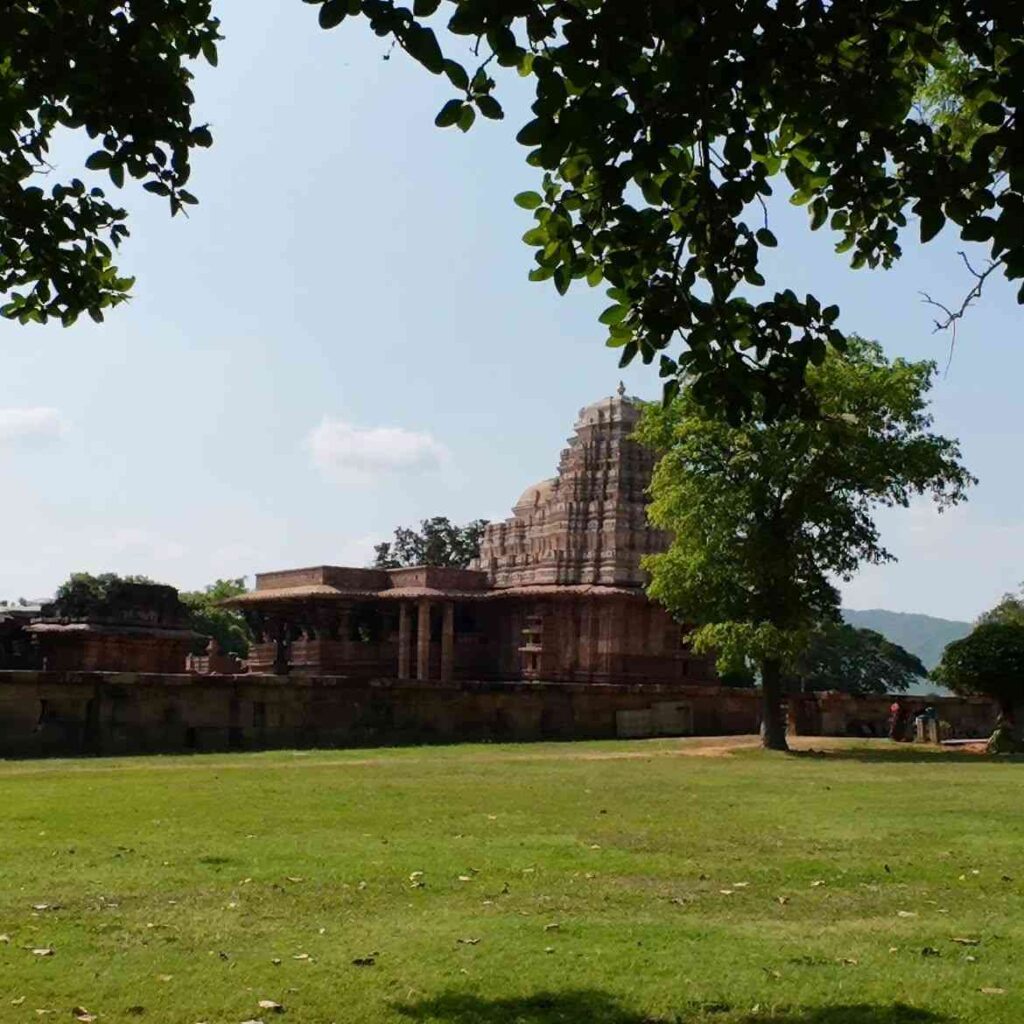
Ramappa Temple is one of the best historical photography locations in Telangana.
Almost every side of the structure provides a different composition. The raised platform, stone pillars, detailed sculptures and pyramidal tower make it easy to capture beautiful Ramappa Temple photos.
I clicked most of my pictures outside the main shrine.
I was very careful because I did not want to touch, lean against or accidentally damage any part of this centuries-old structure. Visitors should never climb on the platform edges or sculptures simply to take a better photo.
During my visit, photography appeared to be permitted in certain interior areas, but I kept the flash switched off.
Photography rules can change, especially inside a protected monument and active place of worship. Before taking Ramappa Ramalingeshwara Temple photos inside, ask the priest, local staff, guide or security personnel for permission.
You can capture hundreds of Ramappa Temple pictures, but no photograph is worth damaging a monument that has survived for more than 800 years.
Clean and Well-Maintained Temple Premises
One thing I immediately appreciated was the cleanliness of the complex.
The walking areas were maintained well, and the peaceful surroundings made it comfortable to explore the temple slowly. Benches were also available at different places where visitors could sit and relax.
Some conservation and construction work was taking place in parts of the complex during my visit.
Ramappa Temple has been protected as a monument of national importance since 1914 and is maintained by the Archaeological Survey of India. Conservation work is necessary to protect damaged sections and preserve the original structure for future generations.
Visitors should not enter fenced or restricted areas, even if they appear suitable for photography.
Washroom Facility at Ramappa Temple
Washrooms were available a short distance from the main temple.
During my visit, the charge was ₹5 per person. The washroom was surprisingly clean and properly maintained, which was good to see at a tourist destination.
Carry small cash because digital payment may not always be available for minor charges.
The shoe stand and parking were free during my visit, while only the washroom required a small payment. These charges may change, so treat them as my personal visit experience rather than a permanent official price.
Sitting Quietly Inside the Temple Complex
After walking around the temple and taking photos, I sat on one of the benches.
The weather was pleasant, and the complex was not very crowded. Instead of leaving immediately, I spent some time simply enjoying the surroundings.
During my recent trips, I have realised that both short and long rides are necessary in life.
Travel gives us a break from the same routine, but it also shows us how much history and natural beauty India has. Before this journey, Ramappa Temple was only another place that I had seen in reels and online photos.
After visiting it, I understood the knowledge and patience behind its construction.
An 800-year-old temple was standing in front of me, while I had travelled only two hours from Karimnagar to reach it.
That thought stayed in my mind while I sat on the bench.
After a few peaceful minutes, I randomly opened Google Maps to check what else was nearby.
That was when I noticed Ramappa Lake View Point, located only around 1.2 km from the temple.
I immediately decided to start my bike and explore it before returning home.
Visiting Ramappa Lake View Point
After sitting peacefully inside the temple complex, I randomly opened Google Maps to check whether there were any nearby attractions.
That was when I found Ramappa Lake View Point.
It was only around 1.2 km from Ramappa Temple, so there was no reason to miss it. I returned to the parking area, unlocked my helmet, started my bike and followed the map towards the lake.
Within a few minutes, I reached the viewpoint.
My First View of Ramappa Lake
The view of Ramappa Lake was beautiful and peaceful.
The large water body, open surroundings and pleasant weather created a completely different atmosphere from the temple. After spending time observing detailed stone architecture, sitting near a calm lake felt refreshing.
Ramappa Lake is not only a tourist attraction. It is another example of Kakatiya engineering.
This means Ramappa Temple and Ramappa Lake are historically connected parts of the same landscape.
Boating at Ramappa Lake
Boating facilities are generally available at Ramappa Lake.
However, boating was not operating when I visited. I travelled during the off-season, and there were very few visitors around the lake.
Boating operations may depend on the season, water level, weather and number of visitors. If boating is important to your trip, check its availability locally before making plans.
Even without a boat ride, I enjoyed the lake.
I walked around the viewpoint, clicked photographs and took a few selfies. Since the place was not crowded, I could spend time there without rushing or waiting for a photography spot.
Visitors should avoid going too close to the water, especially during the monsoon or when the water level is high. Follow local instructions and do not enter restricted sections for photos.
Starting My Return Journey to Karimnagar
After spending a few peaceful minutes at Ramappa Lake, it was time to return home.
I started my bike and continued towards Karimnagar using the same route. The return journey took approximately two hours.
The ride gave me enough time to think about everything I had seen that day.
I had started the journey after watching a short Instagram reel. By the end of the trip, I had visited an 800-year-old UNESCO World Heritage Site, taken darshan of Ramalingeshwara Swamy, observed Kakatiya stone carvings and discovered the historic Ramappa Lake.
This is what I love about travelling.
Sometimes a place looks like a simple weekend destination on Google Maps. Only after visiting it do we understand how much history, craftsmanship and local culture are connected to it.
After completing another one-day journey, I reached home, freshened up and returned with dirty riding gear and another beautiful memory.
Best Time to Visit Ramappa Temple
The best time to visit Ramappa Temple is from October to March, when the weather is comparatively pleasant.
| Season | What to expect |
| October to March | Comfortable weather for exploring the temple and nearby attractions |
| July to September | Green surroundings and better lake views, but expect rain |
| April to June | Hot weather, especially during the afternoon |
| Weekdays | Usually quieter than weekends and holidays |
| Early morning | Pleasant temperature, softer light and fewer visitors |
If you are visiting during summer, reach the temple early in the morning. The stone surroundings and open areas can become hot by afternoon.
The monsoon brings greenery to the region, but riders should watch for wet roads, potholes and slippery surfaces.
Ramappa Temple Timings
Ramappa Temple is commonly listed as being open from approximately:
6:00 AM to 6:00 PM
Timings may change during festivals, special rituals, public holidays or conservation work. Confirm the schedule locally before travelling a long distance.
Try to reach between 7:00 AM and 10:00 AM if you want pleasant weather and enough time to explore Ramappa Lake and other nearby places.
How to Reach Ramappa Temple?
Ramappa Temple is located at Palampet village in Mulugu district, Telangana.
It is accessible by road from Karimnagar, Warangal, Mulugu and Hyderabad.
Karimnagar to Ramappa Temple
The route I personally followed was:
Karimnagar → Kesavapatnam → Parkal → Ghanpur → Ramappa Temple
- Approximate distance: 108 km
- Travel time: Around 2–2.5 hours
- Best option: Bike, car or private taxi
- Road condition during my trip: Mostly good, with some widening work
Be careful near villages where paddy may be dried beside the road. It can reduce the usable road width and make sudden braking risky for two-wheelers.
Hyderabad to Ramappa Temple
A commonly used road route from Hyderabad is:
Hyderabad → Ghatkesar → Bhongir → Jangaon → Hanamkonda → Mulugu → Palampet
- Approximate distance: 200–215 km
- Travel time: Around 4.5–5 hours
- Best option: Car, bike, private taxi or tourism package
Start from Hyderabad by around 5:00 AM or 6:00 AM if you want to complete the trip in one day.
Warangal to Ramappa Temple
Ramappa Temple is approximately 67–75 km from Warangal, depending on your starting point and route.
The journey generally takes around 1.5–2 hours.
A commonly followed route is:
Warangal/Hanamkonda → Mulugu Road → Mulugu → Venkatapur → Palampet
Distance to Ramappa Temple
| Starting place | Approximate distance | Expected travel time |
| Karimnagar | 108 km | 2–2.5 hours |
| Warangal/Hanamkonda | 67–75 km | 1.5–2 hours |
| Mulugu | 15–20 km | Around 30 minutes |
| Hyderabad | 200–215 km | 4.5–5 hours |
| Laknavaram Lake | Around 29 km | 45–60 minutes |
| Ramappa Lake View Point | Around 1.2 km | 5 minutes |
Distances can vary according to the selected route, starting location, diversions and road conditions. Check Google Maps before beginning the journey.
How to Reach Ramappa Temple by Bus?
Travellers using public transport can first reach Warangal, Hanamkonda or Mulugu.
Direct buses connect Hyderabad with Mulugu and other major towns in the region.
From Mulugu, enquire about local buses travelling towards Palampet or hire an auto or taxi to Ramappa Temple.
Bus schedules and routes may change, so confirm the latest service at the bus-station enquiry counter. Public transport is possible, but a private vehicle offers more flexibility if you also want to visit Ramappa Lake, Kota Gullu or Laknavaram Lake.
How to Reach Ramappa Temple by Train?
Ramappa Temple does not have a nearby railway station.
Warangal and Kazipet are the most practical major railway stations for most visitors. Both receive trains from Hyderabad and several other Indian cities.
After reaching Warangal or Kazipet, continue towards Ramappa Temple by bus, cab or rented vehicle.
Allow around two hours for the road journey from the railway-station area, depending on traffic and your chosen mode of transport.
Nearby Places to Visit from Ramappa Temple
Ramappa Temple can be combined with several historical and natural attractions.
| Nearby attraction | Approximate distance from Ramappa Temple | Why visit |
| Ramappa Lake View Point | 1.2 km | Peaceful lake views and seasonal boating |
| Ghanpur Group of Temples—Kota Gullu | 9–11 km | Another important group of Kakatiya temples |
| Padmakshi Temple | 64 km | Historic temple |
| Ekashila Gutta | 68 km | City hills view |
| Laknavaram Lake | Around 29 km | Forest views, suspension bridge and boating |
| Pakhal Lake | Around 55–60 km | Large historic lake surrounded by greenery |
| Thousand Pillar Temple | Around 65–70 km | Famous Kakatiya temple in Hanamkonda |
| Bhadrakali Temple | Around 65–70 km | Historic temple beside Bhadrakali Lake |
| Warangal Fort | Around 70 km | Kakatiya gateways, ruins and historical structures |
Travel distances are approximate and should be checked before starting.
Can Ramappa Temple and Warangal Attractions Be Covered in One Day?
Yes, Ramappa Temple and a few major Warangal attractions can be covered in one day if you start early and travel by private vehicle.
A possible itinerary is:
| Time | Suggested activity |
| 6:30 AM | Start from Warangal or Hanamkonda |
| 8:00 AM | Reach Ramappa Temple |
| 8:00–10:00 AM | Darshan and architecture exploration |
| 10:15 AM | Visit Ramappa Lake |
| 11:00 AM | Start towards Warangal |
| 1:00 PM | Lunch |
| 2:00 PM | Visit Thousand Pillar Temple |
| 3:30 PM | Visit Bhadrakali Temple |
| 5:00 PM | Visit Warangal Fort if time permits |
This schedule is possible but slightly busy.
Facilities Available at Ramappa Temple
| Facility | My visit experience |
| Two-wheeler parking | Available and free |
| Four-wheeler parking | Open parking ground available |
| Shoe stand | Available and free |
| Temple entry | Free during my visit |
| Washrooms | Available at a short distance |
| Washroom charge | ₹5 during my visit |
| Photography | Appeared to be allowed in selected areas |
| Drinking water and food | Carry your own water and basic snacks |
| Benches | Available inside the complex |
These details reflect my visit and may change later.
Estimated Travel Budget from Karimnagar
My round-trip distance was approximately 216 km, excluding small diversions.
| Expense | Estimated cost |
| Fuel for the round trip | ₹800 |
| Temple entry | Free during my visit |
| Parking | Free during my visit |
| Shoe stand | Free during my visit |
| Washroom | ₹5 |
| Food and water | ₹40 |
| Ramappa Lake boating | Not included; unavailable during my visit |
| Emergency buffer | ₹200 |
| Estimated total | ₹1200 |
Fuel cost will depend on your motorcycle or car mileage and the petrol price on the day of travel. Food, boating and other tourism charges may also vary.
My Overall Review of Ramappa Temple
Ramappa Temple was one of the most meaningful heritage trips I completed from Karimnagar.
I originally planned the ride after seeing an Instagram reel. However, the real experience was much bigger than the short video that inspired me.
The peaceful Shiva darshan, detailed Nandi statue, artistic pillars, expressive sculptures, clean premises and nearby lake made the 108 km journey completely worthwhile.
My only regret was not having enough knowledge to understand every sculpture.
If I visit again, I would like to take help from a knowledgeable guide and spend more time studying the different carvings.
Final Thoughts
Ramappa Temple should not be treated as only another tourist attraction near Warangal.
It is a living Shiva temple, a record of Kakatiya engineering and one of Telangana’s most important historical monuments.
If you live in Karimnagar, Warangal or Hyderabad, it is a perfect destination for a weekend heritage trip. With proper planning, you can also combine it with Ramappa Lake, Kota Gullu, Laknavaram Lake or the major attractions of Warangal.
After completing this journey, I again realised why both short and long rides are necessary in life.
They take us away from our routine and show us what India has protected for centuries.
I returned home with dusty riding gear, hundreds of photographs, new knowledge about the Kakatiya dynasty and one more memory that made the weekend meaningful.
This journey is complete, but my ride across Telangana continues.
Stay tuned for the next travel story.
Frequently Asked Questions
Where is Ramappa Temple?
Ramappa Temple is located at Palampet village in Venkatapur Mandal of Mulugu district, Telangana. It is approximately 67–75 km from Warangal, 108 km from Karimnagar and around 200–215 km from Hyderabad.
In which district is Ramappa Temple located?
Ramappa Temple is located in Mulugu district, Telangana.
Many people still search for Ramappa Temple in Warangal because the site was historically associated with the wider Warangal region. Administratively, however, it is now in Mulugu district.
What is the importance of Ramappa Temple?
Ramappa Temple is important because it represents the architecture, sculpture and engineering knowledge of the Kakatiya dynasty.
Its detailed dolerite carvings, sandbox foundation, lightweight porous bricks and connection with the surrounding landscape make it architecturally unique. UNESCO inscribed it as a World Heritage Site in 2021.
It is also an active Shiva temple where Lord Shiva is worshipped as Ramalingeshwara Swamy.
Who built Ramappa Temple?
Construction began in 1213 CE under Recharla Rudra, a commander and administrator during the rule of Kakatiya king Ganapati Deva.
The work is believed to have continued for approximately 40 years.
What are the Ramappa Temple timings?
Ramappa Temple is commonly listed as open from approximately 6:00 AM to 6:00 PM.
Timings may change during festivals, holidays, rituals or conservation work, so confirm locally before visiting.
Is photography allowed at Ramappa Temple?
Photography appeared to be allowed in several exterior and selected interior areas during my visit.
Keep the flash switched off and ask local staff before photographing inside the shrine. Do not touch or climb on the carvings for photos.
Is there an entry fee at Ramappa Temple?
Entry was free during my visit.
Parking and the shoe stand were also free. I paid ₹5 to use the clean washroom facility. Charges may change later.
How much time is required to explore Ramappa Temple?
Keep at least 1–2 hours for darshan, architecture, photography and walking around the complex.
Add another 30–60 minutes if you are visiting Ramappa Lake.
Can I visit Ramappa Temple and Laknavaram Lake on the same day?
Yes. Laknavaram Lake is approximately 29 km from Ramappa Temple, and both places can be included in one day with a private vehicle.
Start early so that you have enough time for darshan, photography, food breaks and lake activities.
Solo traveller, biker, and explorer sharing honest travel guides, hidden places, and unforgettable road trips across India.